Wenzhou Prance Hydraulic Equipment Co., Ltd

Why must a hydraulic pump datasheet be read with the duty record?
A hydraulic pump datasheet is read against the duty record, not in isolation: compare displacement, speed range, continuous and peak pressure, inlet requirements, fluid viscosity and temperature, mounting, shaft, rotation and control fields with the actual operating point before requesting a quote.
Part 1. Why must a hydraulic pump datasheet be read with the duty record?
A datasheet describes one pump model under stated test or application assumptions. The selection decision therefore requires the machine’s flow, speed, pressure, fluid, inlet and installation data on the same page as the catalog values.
Parker and Danfoss technical literature present displacement, speed, pressure and fluid limits together because a single headline rating cannot prove fit. Treat the datasheet as the supplier’s model-specific evidence, not as a generic pump tutorial or a replacement guarantee for another brand.
Buyers who skip the duty record often compare catalog pages by pressure alone. That shortcut hides speed limits, inlet requirements, fluid temperature effects and control differences that can invalidate an otherwise attractive datasheet line.
Part 2. How should displacement, flow and speed fields be checked?
Start with required theoretical flow and actual pump-shaft speed, then confirm that the datasheet displacement and permitted speed range bracket the duty. For a fixed-displacement pump, flow changes with speed; for a variable-displacement pump, also confirm the available displacement setting at the planned control position.
| Datasheet field | Buyer question | Why it matters |
|---|---|---|
| Displacement | Does the model provide the required flow at the actual speed? | Defines the basic flow capability |
| Speed range | Is the planned speed inside continuous and maximum limits? | Operating outside range can affect performance and life |
| Flow note | Under which pressure, fluid and temperature was flow stated? | Ratings are condition-specific |
Use the hydraulic pump flow calculation guide to set the required flow before comparing datasheet values. For mobile equipment, also review how to select hydraulic pump displacement for mobile equipment so the speed reference is the pump shaft, not an assumed engine speed.
Part 3. How do continuous and peak pressure ratings affect selection?
Identify the machine’s continuous operating pressure and any short peak events, then compare each point with the datasheet’s continuous, rated and maximum values. A pump that satisfies peak pressure for a brief event may still be unsuitable if the continuous duty sits outside the documented range.
Manufacturers often publish flow at a low test pressure and list higher pressure limits separately. The buyer must decide whether the real circuit spends most of its time near the continuous rating or repeatedly crosses into an intermittent zone. Cycle time matters as much as the peak number.
Do not assume that a higher catalog pressure automatically makes a pump better for the application. The correct comparison is whether the documented pressure, speed and fluid combination matches the real cycle and protection strategy in the circuit.
Part 4. Which inlet, fluid and mounting fields change the answer?
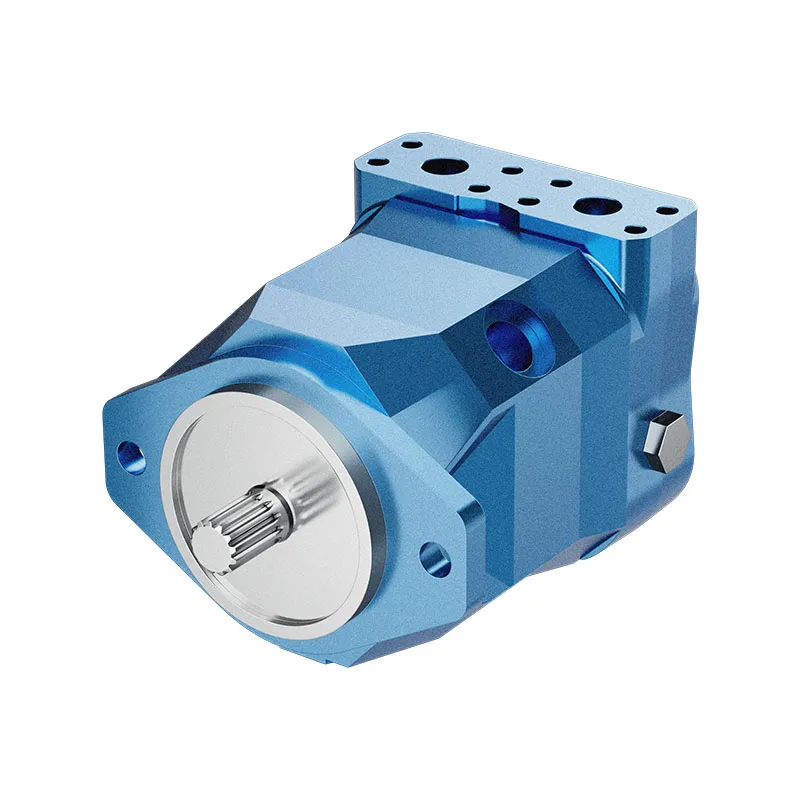
Inlet pressure, permissible suction conditions, fluid type, viscosity range, temperature limits, filtration guidance, mounting flange, shaft dimensions and rotation must match the installation. A datasheet value for inlet pressure is meaningless if the buyer’s suction line, reservoir height or cold-start fluid state differs from the stated assumptions.
Cold fluid, long suction routing, undersized lines and return disturbance near the suction area can all change whether the datasheet rating is usable in the field. Review the hydraulic pump inlet conditions checklist before concluding that a datasheet-supported model fits the installation.
Mounting and shaft details are equally binding. A datasheet that matches pressure and flow on paper can still fail in service when port orientation, flange pattern, shaft extension or rotation direction do not match the machine interface.
Control fields deserve the same discipline. A variable-displacement pump datasheet may list permitted control options, feedback devices or torque-limiter behavior that the machine circuit does not use. Confirm that the requested control architecture is both available and necessary before shortlisting the model.
Part 5. How should buyers compare two datasheet options safely?
Compare like with like: same fluid, temperature, speed, pressure point, inlet condition and control requirement. If one catalog uses a standard test speed and another uses a different reference condition, normalize the comparison before choosing a size.
| Comparison step | Safe practice | Do not do this |
|---|---|---|
| Model A vs Model B | Compare at the same duty point and fluid state | Choose from brand reputation alone |
| Replacement review | Match displacement, ports, shaft, rotation and control | Match only the mounting flange |
| Mobile equipment | Include PTO/gear ratio and cycle profile | Use engine speed as pump speed |
A datasheet from another manufacturer does not prove interchangeability. Use it only as a reference for the engineering questions that must be answered again on the replacement model’s own documentation.
When two datasheets appear close on displacement and pressure, compare efficiency notes, inlet requirements and service factors next. Small differences in those fields often decide which model remains acceptable across the full machine cycle.
Part 6. What should be attached to a pump RFQ?
Send the supplier:
- required flow and actual pump speed range;
- continuous and peak pressure with duty-cycle timing;
- fluid type, viscosity range, cleanliness target and temperature range;
- inlet routing, measured or calculated inlet pressure and reservoir arrangement;
- mounting, shaft, rotation, port orientation and control requirement;
- application, quantity and any required documentation; and
- the datasheet pages already reviewed, with the intended model highlighted.
Use the variable axial piston pump A11VO route only after those records are complete. The datasheet review selects a candidate family; the supplier must confirm the exact model and configuration. Submit the package through the contact page.

FAQs
What should you check on a hydraulic pump datasheet?
Check displacement, speed range, pressure ratings, inlet requirements, fluid limits, mounting, shaft, rotation and control information against the actual duty record.
How do displacement and speed appear on a pump datasheet?
They are usually listed as displacement per revolution and permitted speed range, often with a flow note at a stated test speed and condition.
What is the difference between continuous and peak pressure on a datasheet?
Continuous pressure applies to the normal operating duty, while peak or intermittent values apply to short events. The real cycle profile decides which value controls selection.
Why do inlet pressure and fluid viscosity matter on a datasheet?
They define whether the pump can be supplied correctly at the planned operating point. Inlet and fluid assumptions are part of the rating, not optional installation details.
Can one datasheet be used to replace another pump model?
No. A replacement review must compare displacement, pressure, speed, ports, shaft, rotation, controls, fluid and application conditions across both models.
What information should be sent with a pump RFQ?
Send the duty record, installation data, fluid state, reviewed datasheet pages and the intended operating points so the supplier can confirm model fit.