Wenzhou Prance Hydraulic Equipment Co., Ltd.

Hydraulic Valve Repair or Replacement: Leakage, Spool Damage, and Control
A hydraulic valve is worth repairing when the defect and repair boundary are clear, the correct service parts are available, and testing can demonstrate the required flow-control, sealing, and electrical behavior. Replacement is usually the better starting point when the valve cannot be identified reliably, critical metering or sealing surfaces cannot be restored with verified methods, or the recovery cost and uncertainty exceed those of a confirmed replacement. A leaking valve does not automatically need a complete new assembly, and a moving solenoid does not automatically prove that the repaired valve is fit for service.
This guide helps maintenance and purchasing choose a recovery option. It focuses on repair scope and acceptance evidence rather than repeating a valve interchange checklist or a general troubleshooting procedure.
Identify the function before judging the defect
A directional valve routes flow; a pressure-control valve manages a pressure-related function; a flow-control arrangement influences delivered flow or actuator speed. The required repair evidence depends on that function. A valve used in load holding or another protective function needs a different assessment from one whose failure only prevents an unloaded actuator from moving.
Record the full model code, circuit symbol, operating positions, voltage and connector information where applicable, and the actual machine symptom. Do not assume that two valves with the same mounting footprint perform the same function. The symbol and configuration matter to the repair decision because a workshop must know what the assembly must do before it can claim that function has been restored.
Distinguish external leakage from internal leakage
An external leak at a connector, face seal, or threaded interface may have a local cause. A poor mating surface, incorrect sealing arrangement, installation damage, or another condition can remain after a seal is changed. Inspect the complete interface rather than assuming every external leak is a defective O-ring.
Internal leakage is a different question. Some valve designs permit a defined amount of internal leakage; others use seating arrangements intended for a different level of sealing. Interpret the observation against the exact design and test conditions. There is no universal flow value that condemns every spool or seat valve. Record the pressure difference, fluid temperature, measured path, and valve state so that a repair provider can evaluate the relevant function.
Separate coil service from hydraulic-body repair
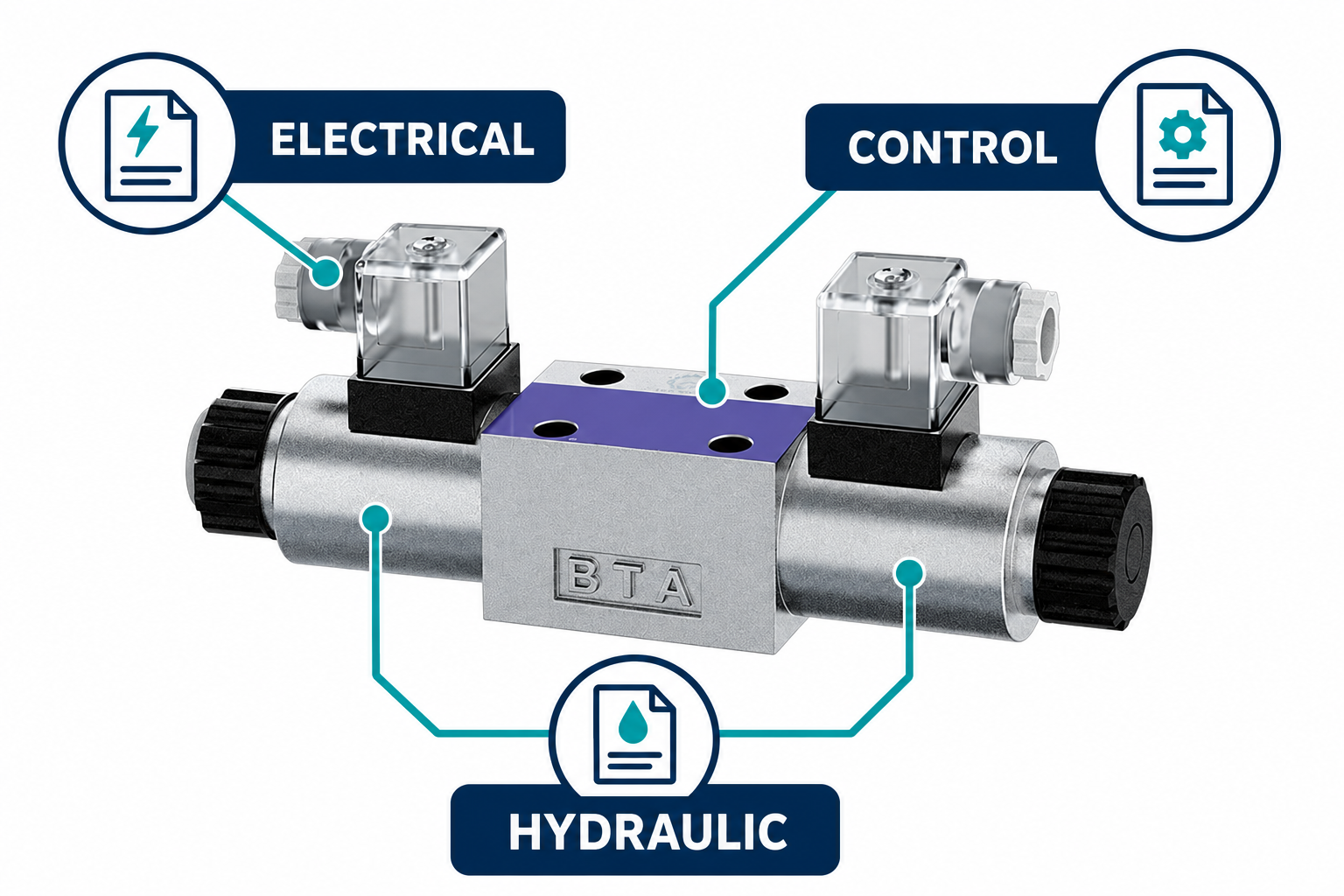
A replaceable coil or connector may be serviceable without opening the hydraulic body, provided the model documentation permits the work and the correct parts are used. The coil, connector, voltage, duty, and any suppression or electronics must still match. A coil with the correct physical size can have different electrical requirements.
Hydraulic-body work may involve precision surfaces, clearances, springs, pilot passages, or contamination-sensitive assemblies. Do not extend a simple coil replacement into uncontrolled dismantling. For valves with integrated electronics or position feedback, include the electronic and feedback functions in the repair boundary. Replacing a coil does not demonstrate the condition of a spool, and freeing a spool does not prove that an amplifier or sensor operates correctly.
Do not confuse cleaning with restoration of damaged surfaces
Contamination can prevent a valve from moving or sealing as intended, but cleaning is not a universal repair. Abrasion, corrosion, impact damage, or altered precision surfaces may remain after debris has been removed. The workshop must distinguish removable contamination from permanent damage using the appropriate criteria.
Avoid unapproved polishing, lapping, drilling, spring substitution, or adjustment as a way to make a stuck valve appear operational. Such changes can alter metering, response, sealing, or pressure behavior. A valve that moves more freely after modification may no longer match the original specification. If the work changes the functional characteristics, it requires a reviewed engineering change rather than a repair label implying the original behavior has been restored.
Use a function-based decision table
| Entdeckung | Potentially suitable service scope | Evidence needed before release |
|---|---|---|
| Identified connector defect | Replace the correct connector or damaged external component | Electrical compatibility and complete circuit function |
| Local external seal problem | Renew specified seals and correct the mating interface | Exact seal material, installation condition, and leak check |
| Contamination-related sticking | Controlled inspection and cleaning if permitted | No unacceptable surface damage and repeatable operation |
| Damaged metering or seating surfaces | Specialist assessment or replacement | Verified restoration method and applicable performance test |
| Electronic or feedback fault | Approved module service or matched replacement | Correct signal, configuration, feedback, and hydraulic response |
| Uncertain valve identity | Further identification before committing | Confirmed symbol, code, interfaces, and operating requirements |
The table does not prescribe a repair procedure or dimensional limits. It identifies what a proposed recovery option would need to prove.
Compare the cost of a functioning assembly
The meaningful comparison includes diagnosis, removal, parts, workshop work, cleaning, installation, control checks, testing, and downtime. Replacement can introduce its own cost if the exact configuration is unavailable and an alternative needs interface or control changes. Repair can introduce uncertainty if the final scope depends on damage discovered during inspection.
Ask each quotation to state its boundary. Does it include the coil and connector? Are seals supplied for the mounting face? Does testing include the required function in each position? Who handles contaminated fluid or a damaged subplate? A low component price is not an equivalent offer when one provider has excluded work needed to return the machine to service. Maintenance decisions should consider consequences and total recovery cost, rather than a fixed percentage of new-valve price.
Define what bench testing must establish
For a directional valve, relevant observations may include commanded position changes, specified leakage paths, pressure drop under defined flow, and stable behavior after repeated operation. For pressure or flow functions, tests must match the design and agreed acceptance requirements. The selection of conditions belongs in the test agreement, not in a generic pass label.
Record fluid, temperature, pressure, flow, applied electrical conditions where relevant, measurement locations, and assembly identity. Distinguish a static check from dynamic behavior. An audible coil click or manually moved override is not proof that every hydraulic path behaves correctly. Where a bench cannot reproduce the installed duty, identify the remaining machine-level verification instead of claiming the bench has validated the whole circuit.
Review the mounting interface separately
A repaired valve can leak again if the subplate or manifold face is damaged, seals are incorrect, passages are mismatched, or installation loads distort the assembly. Conversely, installing a new valve does not repair a defective mounting surface. Evaluate the valve and mating interface as connected but separate items.
Use the approved mounting drawing and installation instructions for seal arrangement, fasteners, tightening requirements, and surface condition. Do not adopt a torque value from a similar footprint or another valve series. The replacement or repair decision should make clear whether interface restoration is included, who inspects it, and which evidence will be recorded before the assembly is returned to operation.
Handle protective functions and stored energy deliberately
Servicing a valve can change whether a cylinder, motor, or supported load moves. Isolate the machine under its approved procedure, restrain hazardous movement, and address stored hydraulic or mechanical energy before opening connections. An electrically disconnected valve can still be exposed to pressure or loads elsewhere in the circuit.
If the valve contributes to a protective function, its recovery must be assessed within that function. Do not substitute a superficially similar spool or pressure element because it fits the housing. The competent person responsible for the machine must review the intended behavior and required validation. This article supplies a purchasing and planning framework, not authorization to bypass a protective device or change its settings.
Keep the repaired configuration traceable
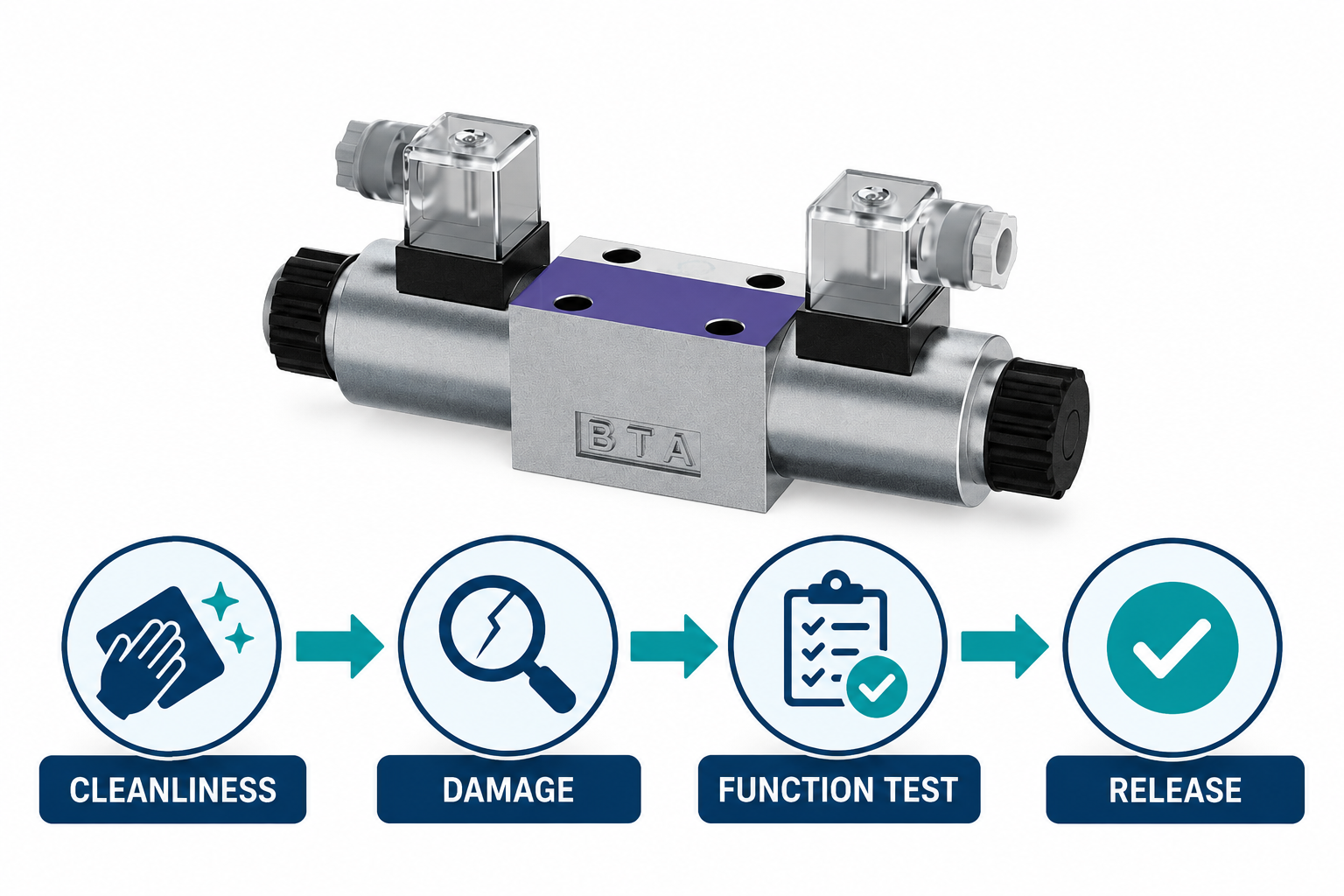
Record the incoming identification, inspection findings, approved scope, replaced parts, final configuration, and test results. If an electrical module, seal material, or other option changes, record the change explicitly and obtain the necessary approval. A later technician should not have to infer the installed version from an old purchase description.
A practical release record states both what passed and what was outside the test. It should connect the workshop result with the machine commissioning result and any corrections to contamination or mounting conditions. This evidence helps the next repair decision and reduces the chance that an intermittent circuit problem is repeatedly charged to the valve without a defensible cause assessment.
Häufig gestellte Fragen
Is cleaning a sticking valve enough?
Only when cleaning is permitted, contamination is the confirmed issue, damage is not unacceptable, and the required function is verified afterward. Cleaning does not restore worn or altered precision surfaces and should not replace a proper assessment.
Does a clicking coil prove the valve is repaired?
No. It is an electrical or mechanical observation under limited conditions. Correct hydraulic routing, leakage, response, and operating behavior must still be checked according to the valve’s function and the agreed test requirements.
Should all seals be changed when a valve is opened?
Follow the exact service instructions and approved repair scope. Seal identity and material matter, and opening some assemblies may not be permitted for ordinary field service. Do not infer an appropriate seal kit from color or external appearance alone.
Is a replacement automatically safer than repair?
A confirmed replacement can reduce repair uncertainty, but it still needs correct configuration, installation, and functional verification. A mismatched new valve or a new valve on a damaged manifold can create a different problem rather than solve the original one.
What makes two repair quotations comparable?
They must cover the same assembly and function, disclose inspection-dependent costs, include equivalent test coverage, and identify exclusions. Compare the complete recovery boundary, delivery confidence, and resulting configuration rather than just the price of listed parts.
Produktdaten und entsprechende technische Ressourcen
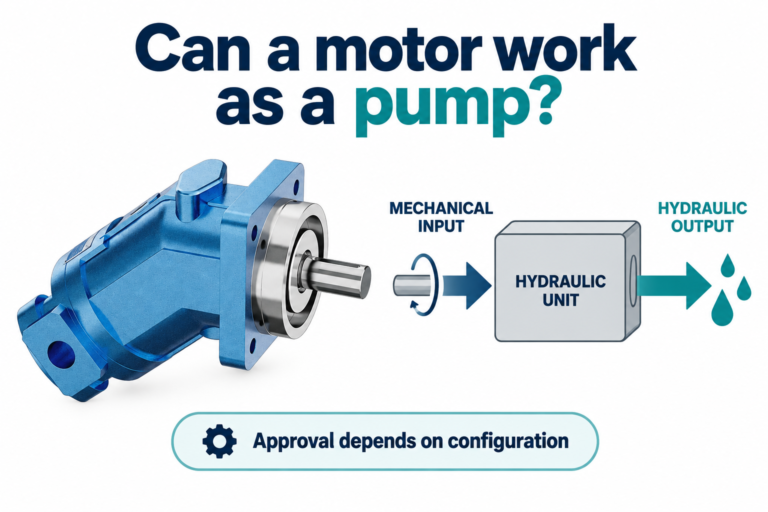
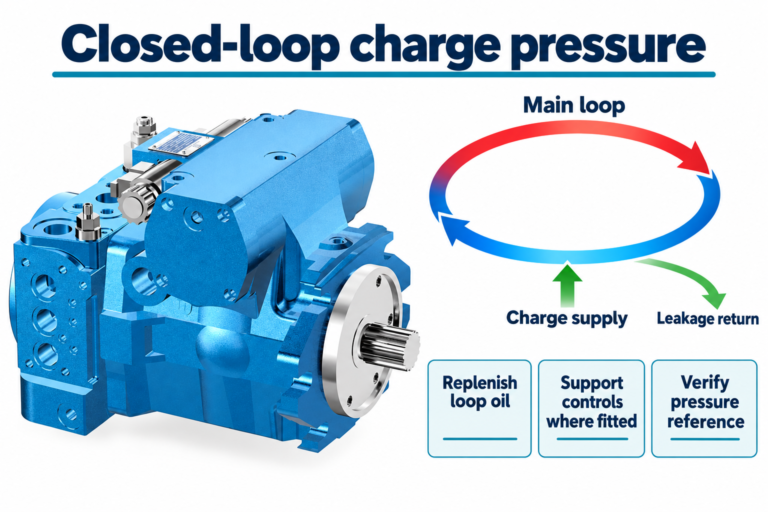
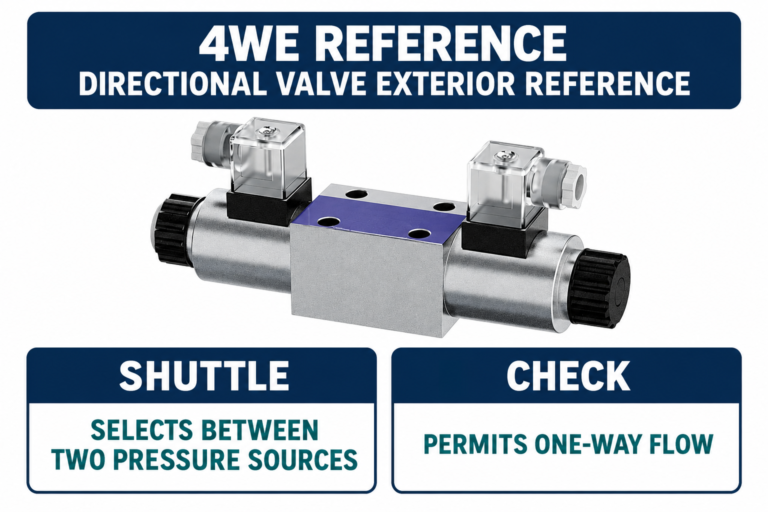
The Directional Valve 4WE catalog exterior is used as the real product reference in these explanatory images. It does not establish the approved service method, optional construction, or operating limits for an individual order. Confirm the complete code and its documentation. Related resources: Wegeventil 4WE, Hydraulikventilpalette, Handbuch zur Austauschbarkeit von Hydraulikventilen: Symbole, Anschlüsse und Leistung, Interner Leckagetest für hydraulische Richtungsventile, Warum klemmen hydraulische Ventilschieber und was sollte überprüft werden?.
Sources and limits of this guide
The university resource supports the component operating principles. NIOSH supplies hazardous-energy prevention context; exact machine isolation and component service requirements still need their approved procedures. NASA supplies a general maintenance decision framework, not hydraulic repair prices or component acceptance limits.
- NPTEL: Grundlagen der industriellen Ölhydraulik und Pneumatik
- NIOSH: Verletzungen durch gefährliche Energie verhindern
- NASA: Reliability-Centered Maintenance Guide
University lesson: operating principles
NPTEL IIT Guwahati presents Lec 31: Flow control and pressure relief valves. The lesson supports the valve operating principles used in the engineering discussion; it is not a model-specific repair, storage, or installation approval.