Wenzhou Prance Hydraulic Equipment Co., Ltd.

Hydraulic Valve Storage and Shelf Life: Seals, Coils, and Release Checks
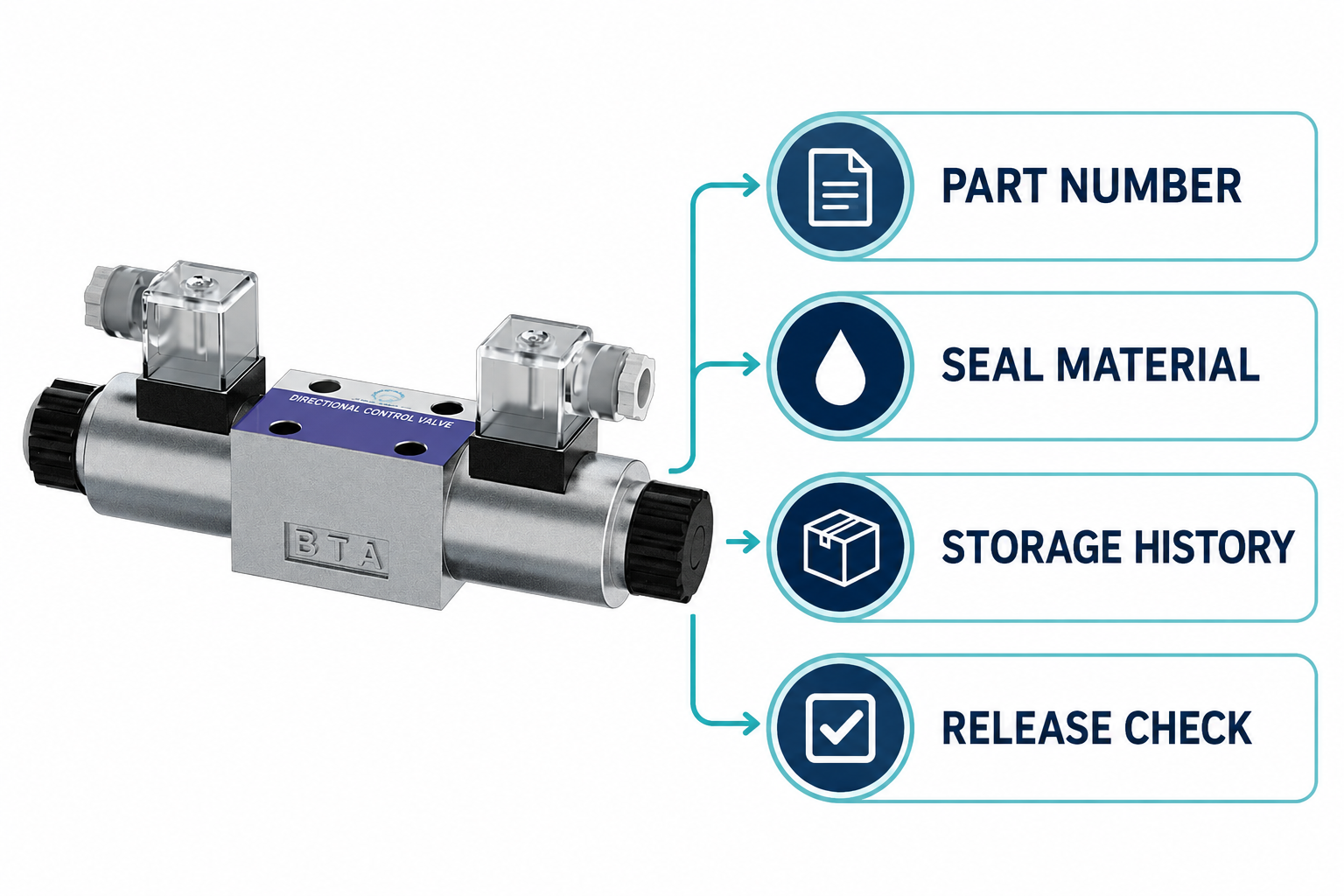
A stored hydraulic valve does not have one universal shelf life that can be determined from its outside appearance or the age of its box. Release depends on the exact assembly, seal materials, electrical equipment, preservation method, packaging, and storage history, together with the supplier’s applicable instructions. Keep the valve identifiable, clean, protected, and separated from uncertain stock. Before installation, verify both the stored condition and its suitability for the current machine.
The question is wider than whether an O-ring has reached a particular age. A complete valve may include several materials and electrical components, and the part of the assembly with an unresolved condition can determine whether the whole item is ready for service.
Distinguish a storage review date from an expiry date
A warehouse may assign a date for inspection, preservation renewal, or document review. That date is a management control, not automatically the manufacturer’s expiry date. Record what each date means. Receiving date, manufacture date, last inspection, and release authorization answer different questions and should not be combined into a single unlabeled field.
When an applicable shelf-life instruction exists, retain the source and its conditions. Determine whether it applies to a seal, coil, electronic module, complete assembled valve, or a specific preservation treatment. Do not transfer an interval from one material to every part in the assembly. If the original date or history is missing, changing the warehouse label does not recreate that evidence.
Identify the complete valve configuration
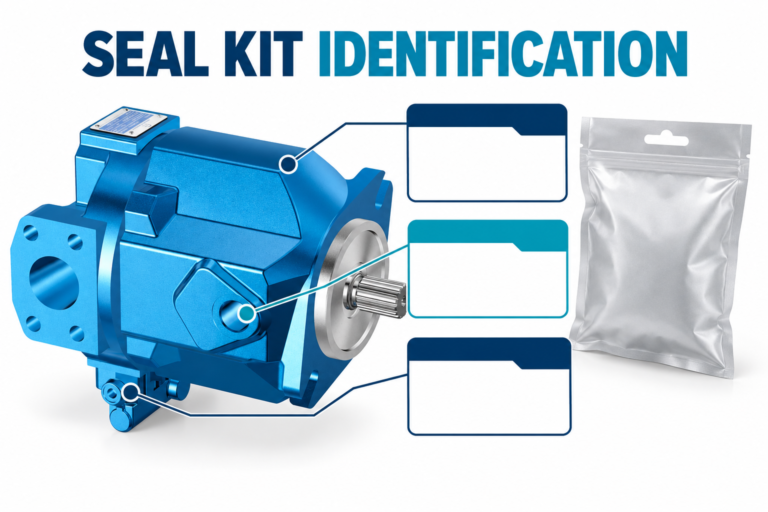
Record the full code, circuit symbol, operating positions, supplied coil or electronics, connector arrangement, seal option where specified, and traceability reference. A directional valve with two externally similar coils can differ in electrical requirements or hydraulic function from another item on the same shelf. The mounting pattern alone is not a stock identity.
Keep photographs as supporting evidence, especially for nameplates and supplied accessories, but retain written codes that can be searched and compared. If the valve was repaired or modified, record the final configuration rather than assuming the original purchase description remains accurate. Separate returned or partially dismantled valves from unused spares so that their different condition is immediately visible during an urgent parts search.
Understand the limited role of rubber-storage standards
The published scope of ISO 2230:2026 concerns storage, inspection, recording, and packaging of rubber products and components. It provides useful context for managing elastomer-containing stock. It does not, from its abstract alone, provide a universal shelf-life number for a complete hydraulic valve or establish whether its electrical module is serviceable.
Use the relevant material and component instructions where a decision requires a limit or specific treatment. This article does not reproduce paid standard clauses or infer exact storage conditions from a standard title. A valve’s release decision needs the actual product information, not a generic claim that its seals are compliant with a storage standard. Preserve the distinction between a reference framework and evidence for the particular assembly.
Protect the hydraulic mounting and connection faces
Keep openings and mating faces protected against dust, water, corrosion, and handling damage with suitable clean packaging or closures. For a subplate-mounted valve, the protected face may contain several passages and sealing positions. A clean-looking exterior does not demonstrate that a previously uncovered face remained uncontaminated.
Inspect packaging without unnecessarily exposing critical interfaces. If a face cover is removed for identification or inspection, use the approved clean handling method and restore protection promptly. Record damage, missing seals, corrosion, or foreign material rather than fitting a new cover and silently returning the item to service-ready stock. Do not use unverified plugs or packaging fragments that could enter hydraulic passages or damage sealing surfaces.
Include coils, connectors, and electronics in storage control
Protect electrical connectors from impact, moisture, contamination, and inappropriate handling. Some assemblies include integrated electronics or feedback devices whose storage and handling requirements differ from a simple coil. Their condition cannot be established by checking the hydraulic face alone.
Do not apply arbitrary power, a high-voltage insulation test, or improvised test leads to an unidentified stored valve. Any electrical check needs the correct pinout, supply, signal, protection arrangement, and approved procedure. A continuity reading alone does not prove that an assembled valve is ready for hydraulic service. Record electrical configuration and visible condition so that the release process can determine which checks are relevant rather than defaulting to one test for every item.
Control the environment and the inventory status
Store the valve under the conditions specified for the component and packaging. Review exposure to water, condensation, corrosive chemicals, dust, and unsuitable heat or other environmental conditions. A shelf inside a building can still be exposed to process fumes or repeated temperature swings that the original packaging was not designed to manage.
Where monitoring or periodic inspection is required, keep the records linked to affected stock. After a significant excursion, classify items for review instead of assuming the protection remained effective. Use clear status categories that distinguish available stock, items awaiting inspection, unknown-condition returns, and rejected or repair-pending assemblies. A physical valve in the warehouse is not necessarily an available spare for planning an outage.
Use condition and evidence to decide the next action
| Finding at stock review | What it means | Required next step |
|---|---|---|
| Complete identity and documented compliant storage | Useful evidence of controlled condition | Continue applicable inspection and release requirements |
| Unknown seal option or missing assembly history | Part of suitability remains uncertain | Identify the configuration before assigning service-ready status |
| Damaged face protection or open hydraulic passage | Possible contamination or interface exposure | Inspect under the approved procedure and assess affected condition |
| Moisture, corrosion, or damaged electrical connector | Visible condition needs competent assessment | Hold the item and determine repair or rejection requirements |
| Expired inspection or preservation review date | A required management action is overdue | Complete the specified review; do not invent a new manufacture date |
| Valve intended for a changed machine | Original purchase identity may no longer be enough | Recheck hydraulic and electrical compatibility before installation |
The table does not define acceptable corrosion, test voltage, or a storage extension. Those decisions require the applicable product evidence.
Decide whether seal renewal is actually the correct response
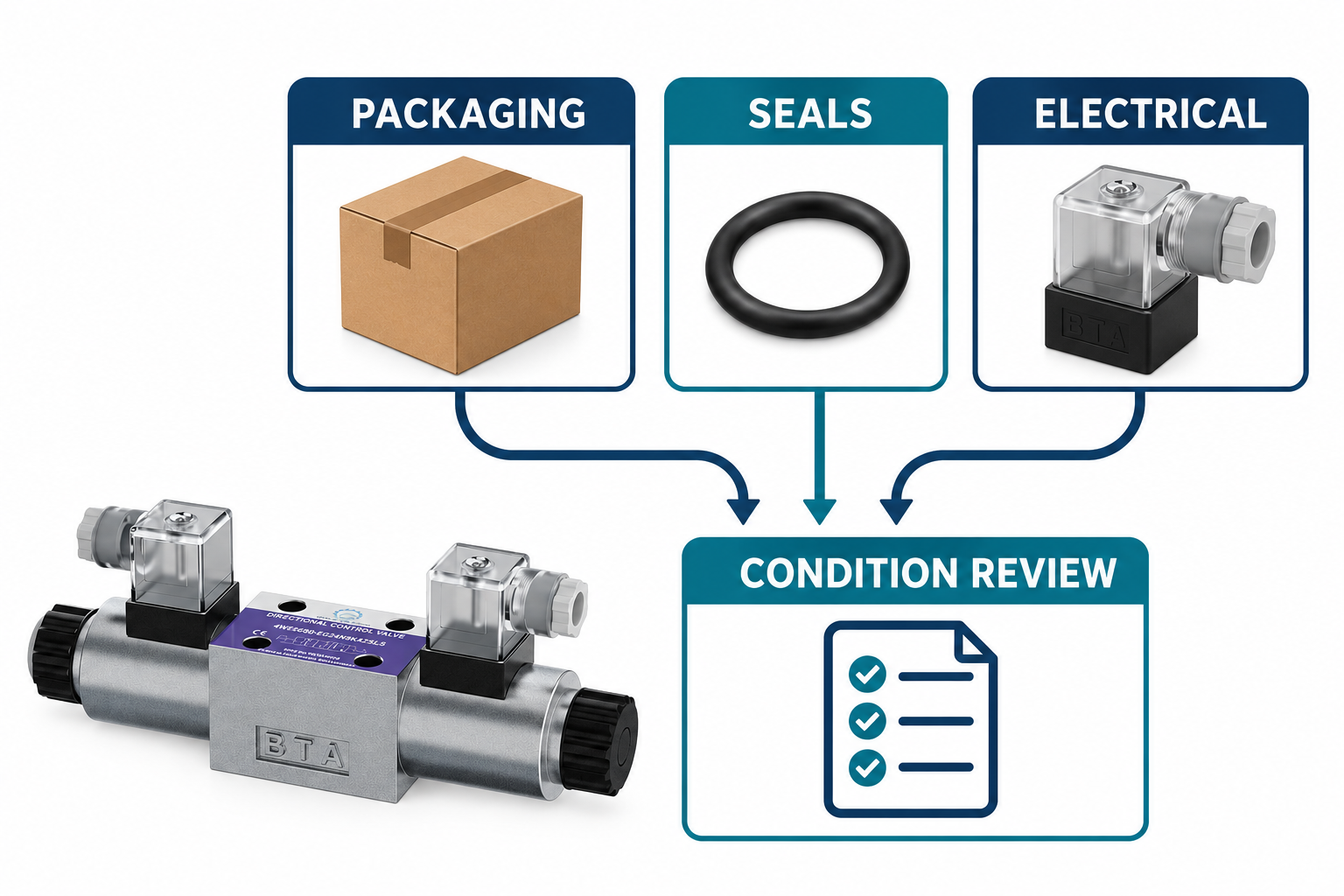
Seal renewal may be required by an approved service instruction or condition assessment, but it is not a universal cure for uncertain storage. Correct material, dimensions, revision, installation method, and cleanliness all matter. A ring with a similar color or diameter is not sufficient identification.
Some assemblies may not be intended for ordinary field disassembly. Opening an otherwise protected valve without a controlled procedure can introduce more uncertainty than it removes. If renewal is appropriate, define the service boundary, keep the replaced-parts record, and specify the test needed afterward. New seals do not automatically establish the condition of precision hydraulic surfaces, coils, connectors, or electronics that were exposed during storage.
Plan release before the machine needs the spare
Compare the stored valve with the current machine requirement early enough to resolve questions. Confirm the hydraulic symbol and each position, mounting and port arrangement, electrical supply and control, pressure and flow requirements, and compatible fluid. The replacement may be unsuitable even when its stored condition is excellent.
Agree on installation materials, cleanliness controls, mounting instructions, and test requirements. Do not borrow a fastening torque or connector pinout from an apparently similar valve. Check that required documents and accessories will reach the installer with the component. This preparation turns a warehouse item into a planned spare and avoids discovering an incompatible coil or missing face seal after the old valve has already been removed.
Complete a controlled return to operation
Service work must follow the machine’s energy-control procedure, including hydraulic and mechanically stored energy. Secure loads and prevent unintended movement before removing a valve or opening connections. An electrical disconnection does not prove that the hydraulic circuit is depressurized or that the load is restrained.
After installation, verify the relevant function under the approved commissioning sequence. Appropriate observations depend on the valve and circuit, and may include routing, leakage, commanded positions, control response, and the intended load behavior. Retain the release inspection, actual installed identity, and commissioning findings with the storage history. This preserves a defensible chain from receipt through storage to service rather than relying on an unqualified claim that the valve was new in its box.
Häufig gestellte Fragen
Do all hydraulic valves expire after the same number of years?
No. A complete assembly can combine different materials and electrical equipment. Apply the actual supplier instructions and storage conditions, and distinguish inspection dates from expiry dates. This guide deliberately does not assign a universal duration.
Does an unopened box guarantee good seals?
No. Packaging is one part of condition control. Material identity, storage history, packaging integrity, environmental exposure, and applicable release requirements still matter. The outside of a box cannot establish every condition inside the valve.
Should every old spare valve be dismantled before use?
Not automatically. Follow the applicable inspection and service instructions. Unnecessary or uncontrolled disassembly can introduce contamination or damage. A competent assessment should decide what work and subsequent testing are justified.
Can a coil resistance check approve the whole valve?
No. It cannot establish all hydraulic functions, correct spool configuration, acceptable sealing, or the condition of every electrical component. Use the correct electrical procedure as one part of a release plan, not as a substitute for it.
What should the warehouse record first?
Capture complete valve identity, condition on receipt, preservation and packaging details, relevant dates with clear meanings, and current stock status. Keep later inspections, excursions, repairs, and release decisions linked to that same assembly.
Produktdaten und entsprechende technische Ressourcen
The Directional Valve 4WE catalog exterior is used as the real product reference in these explanatory images. It does not establish the approved service method, optional construction, or operating limits for an individual order. Confirm the complete code and its documentation. Related resources: Wegeventil 4WE, Hydraulikventilpalette, Materialien für die Hydraulikventilabdichtung: NBR, FKM und EPDM, Test der Hydraulik-Magnetspulenwiderstandsfähigkeit: Ohm und Temperatur, Handbuch zur Austauschbarkeit von Hydraulikventilen: Symbole, Anschlüsse und Leistung.
Sources and limits of this guide
The university resource supports the component operating principles. NIOSH supplies hazardous-energy prevention context; exact machine isolation and component service requirements still need their approved procedures. ISO references identify the stated standard scope. This guide does not reproduce paid clauses or turn their abstract into model-specific limits.
- NPTEL: Grundlagen der industriellen Ölhydraulik und Pneumatik
- NIOSH: Verletzungen durch gefährliche Energie verhindern
- DIN Media official standards entry: ISO 2230:2026, Rubber products, guidelines for storage (scope; not an assembled-component expiry)
University lesson: operating principles
NPTEL IIT Guwahati presents Lec 31: Flow control and pressure relief valves. The lesson supports the valve operating principles used in the engineering discussion; it is not a model-specific repair, storage, or installation approval.