Wenzhou Prance Hydraulic Equipment Co., Ltd

Hydraulic Pump Repair or Replacement: Cost, Damage, and Test Evidence
A hydraulic pump should be repaired when its damage can be defined, the correct parts and procedures are available, and a meaningful test can demonstrate restored performance. Replacement is usually the stronger option when important parts cannot be verified, structural damage makes the repair uncertain, or downtime outweighs the apparent saving. There is no reliable universal rule that a repair is worthwhile below a particular percentage of a new pump’s price. Compare the complete recovery job and the evidence behind each option, rather than comparing a seal kit with the price of a complete assembly.
This guide addresses the decision before an order is placed. It does not replace the installation and interface checks needed after a replacement has been selected, and it does not authorize opening an unfamiliar pump.
Establish whether the pump is responsible
Low actuator speed, heat, noise, and difficulty reaching pressure are machine observations, not a repair specification. A restriction at the inlet, air entering a connection, an incorrectly adjusted control, an open bypass, or internal leakage elsewhere can produce symptoms that appear to implicate the pump. Replacing a healthy pump leaves the original problem in place and may damage the replacement during the same operating cycle.
Ask for comparable measurements at a stated oil temperature, shaft speed, outlet pressure, and control condition. Identify where flow was measured and whether another circuit branch was consuming it. On a pump with a case drain, interpret drain measurements using the exact manufacturer’s procedure; drain flow alone is not a universal condemnation limit. Preserve the initial observations before changing settings, because an undocumented adjustment can erase useful evidence.
Separate external service from internal rebuilding
An external leak with an identified cause is a different repair from replacing damaged pumping elements. Replacing a connector seal may leave all precision hydraulic surfaces undisturbed. An internal rebuild may involve fitted parts, bearing arrangements, control settings, cleanliness requirements, and tests that an ordinary maintenance bench cannot establish.
Request a written scope describing which parts will be inspected, which will be replaced, and which measurements determine whether retained parts are acceptable. The phrase “complete rebuild” is not enough. In a variable piston pump, clarify whether the control assembly, rotating group, shaft bearings, and sealing interfaces are included. Do not assume that changing the rotating group corrects a damaged control, or that a new shaft seal addresses the pressure that caused the old one to leak.
Use the damage report to narrow the options
A useful report connects the damage to a plausible mechanism and states what remains uncertain. Photographs should identify their location and the actual component. A statement that oil was dirty is less useful than a report distinguishing abrasive wear, a bearing problem, corrosion, or an inlet-related failure, while recognizing that several mechanisms can coexist.
Structural damage, uncertain housing integrity, damaged mounting interfaces, or unavailable matched parts can change the decision even when some internals are repairable. These conditions need an assessment by a competent repair provider, not an improvised field judgment. Ask whether the proposed work restores the original specification or produces an assembly with different limits. If the latter is proposed, the machine owner must review the changed specification before treating it as an interchangeable replacement.
Compare the full recovery cost
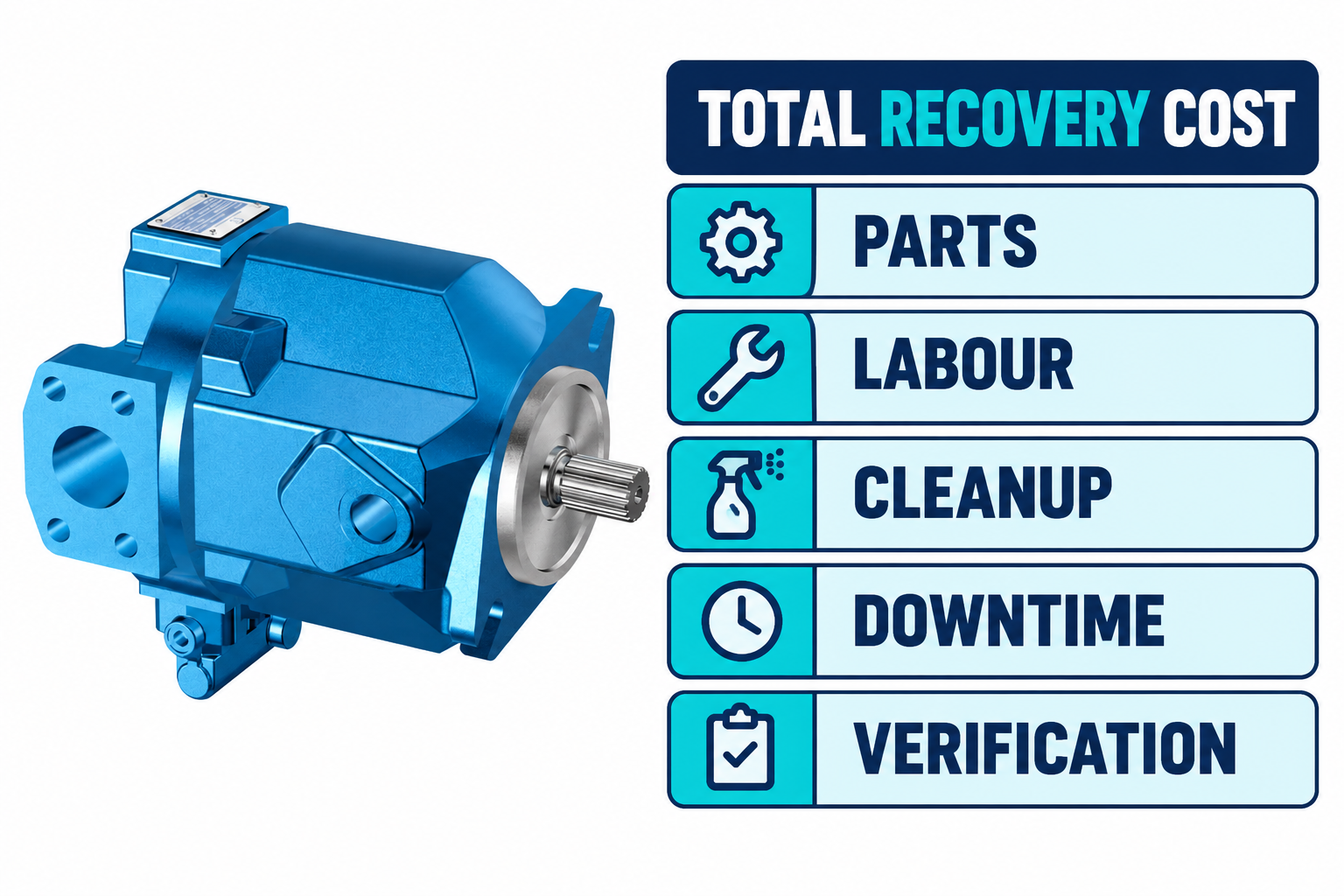
The relevant comparison includes removal, diagnosis, parts, labor, cleaning, filtration or flushing where required, installation, verification, and lost operating time. Some costs apply to both options. Listing them separately prevents a replacement quotation from appearing more expensive merely because it includes work omitted from the repair estimate.
For illustration only, a repair quote of 1,200 currency units plus 600 for removal and installation and 400 for testing totals 2,200 before downtime. A replacement costing 2,500 with the same 600 installation cost totals 3,100 before its verification and downtime costs. These invented figures explain the arithmetic; they are not Prance prices or typical market costs. If the repair adds several days of unavailable production, the lower workshop bill may not deliver the lower total recovery cost.
NASA’s reliability-centered maintenance guidance provides the broader principle: assess consequences and lifecycle costs when choosing maintenance actions. It does not supply a hydraulic-pump repair price threshold or endorse a particular repair supplier.
Put each option against the same decision table
| Fator de decisão | Evidence favoring a defined repair | Evidence favoring replacement or further review |
|---|---|---|
| Damage scope | Localized defect with documented inspection criteria | Structural damage, uncertain extent, or unreliable identification |
| Parts | Correct revision and material are available | Unverified parts or substitutions without engineering approval |
| Performance proof | Suitable test can reproduce required duty | Only an unloaded run or visual check is offered |
| Downtime | Repair completion and testing fit the outage | Repair lead time creates greater operational exposure |
| Original cause | Corrective work is included in recovery | Cause remains unresolved under either option |
| Support | Written scope, exclusions, and service terms | Claims cannot be tied to the actual repaired assembly |
This is a qualitative purchasing aid, not a damage acceptance standard. Exact wear limits, test conditions, and repairability decisions must come from the relevant component documentation and a qualified assessment.
Ask what the test actually proves
A pump that turns without unusual noise has not necessarily demonstrated useful flow at the required pressure and operating temperature. A meaningful test report identifies the assembly, test fluid, temperature, speed, pressure points, relevant control settings, instrumentation, and results. The required coverage depends on the pump and machine duty; no single test point proves every control mode.
For a variable-displacement unit, ask how control behavior is checked as demand changes. For a fixed-displacement unit, ask how delivered flow and leakage-related behavior are evaluated under the agreed conditions. Compare results with an agreed reference, not with an unexplained statement that the unit passed. A repair provider should distinguish measured values from calculated values and identify any tests excluded from the quoted work.
Treat contamination as a separate recovery workstream
A damaged pump can distribute debris through components and plumbing. Installing a repaired or new pump into the same contaminated circuit can trigger another failure. The recovery plan should therefore address the system condition as well as the component invoice. The appropriate method depends on the circuit and the contamination involved; avoid declaring that changing one filter makes every system safe.
Record the reservoir condition, accessible debris findings, filter observations, fluid assessment, and the cleaning or flushing procedure approved for the machine. Components that trap particles may require separate inspection. If a provider quotes only the pump, identify who owns the rest of this work. Both repair and replacement can fail economically when the quotation assumes the machine is already ready for a clean component.
Compare lead time with certainty
A short quoted repair time may depend on finding reusable parts after disassembly. Ask when the estimate becomes a firm scope, what happens if further damage is found, and whether inspection charges still apply when the repair is declined. A replacement quotation can also carry uncertainty if the full model code, control option, or delivery commitment has not been confirmed.
Where downtime is critical, consider the difference between a verified spare, a repaired original, and a new unit that still needs compatibility review. These are different levels of readiness. Do not authorize a questionable repair simply to preserve a schedule, and do not assume a new unit is immediately usable because its basic series name resembles the old one.
Make responsibility and service terms explicit
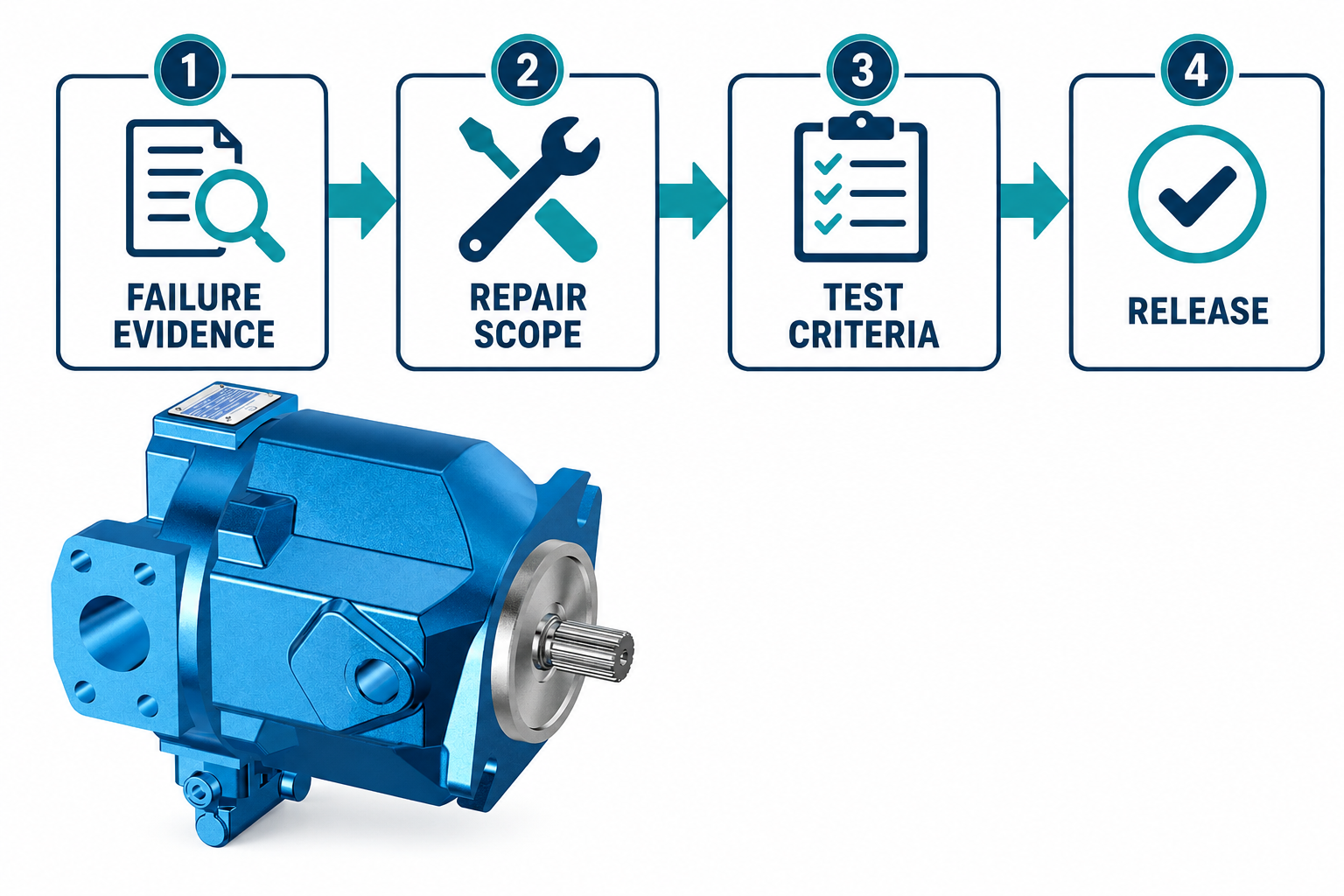
Ask for written terms that identify the repaired or supplied assembly, what the provider warrants, and what conditions or exclusions apply. The commercial meaning of a warranty depends on the agreement; this guide does not interpret legal coverage. More useful than a headline warranty period is clarity about investigation, return handling, test evidence, and responsibility for a repeat problem.
Keep the original identity record even when parts are replaced. Store the final report against the machine and component serial references, together with the cause assessment and corrective actions. This allows a later failure to be compared with the previous event rather than treated as another isolated invoice. It also helps purchasing avoid ordering a seal kit or control revision that no longer matches the serviced assembly.
Release the machine through a controlled restart
Repair and replacement both require machine-specific isolation, installation, filling, control checks, and a staged return to duty. Hydraulic pressure, accumulated energy, and mechanically supported loads must be handled under the site’s energy-control procedure. Stopping the prime mover does not by itself demonstrate that every hazardous energy source has been removed.
Establish the observations that will stop the restart, who can authorize progression, and which conditions must be recorded for comparison. Verify the operating duty that originally exposed the problem rather than accepting an unloaded demonstration as the whole result. The final decision is complete only when the recovered machine can perform the agreed duty safely and the evidence has been retained.
Perguntas frequentes
Is repair worthwhile below half the price of replacement?
That percentage omits too much to be a dependable rule. Include installation, testing, contamination control, downtime, and uncertainty. A lower repair invoice can still produce a higher recovery cost, while a well-defined repair can be sensible when the complete job and performance proof are strong.
Does a new seal kit make a pump rebuilt?
No. A seal kit addresses identified sealing parts. It does not prove the condition of bearings, pumping surfaces, controls, or housing interfaces. Describe the actual work performed and the tests completed instead of relying on an undefined rebuild label.
Should the original pump be dismantled before getting a replacement quote?
Not automatically. First preserve its identity, failure observations, and any service or return requirements. A competent provider may need inspection to price repair, while a replacement supplier may need the intact model information. Agree on the sequence before authorizing irreversible work.
Can replacement eliminate the need to investigate the failure?
No. An inlet restriction, contaminated circuit, incorrect control condition, or installation problem can damage a new unit too. The corrective work must address the machine-level cause regardless of which component recovery option is selected.
What should purchasing request with either quotation?
Request exact identity and configuration, scope, exclusions, delivery assumptions, required installation work, test coverage, acceptance criteria, and service terms. Make the two quotations describe the same recovery boundary so the apparent price difference can be interpreted correctly.
Produtos e recursos de engenharia relacionados
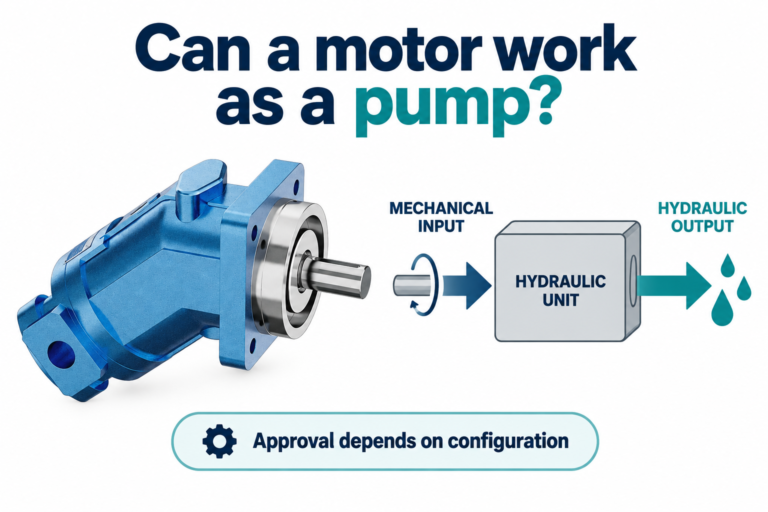
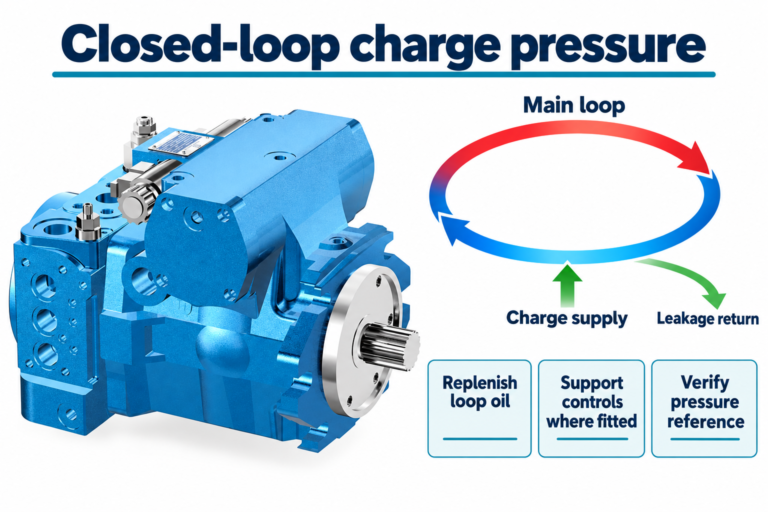
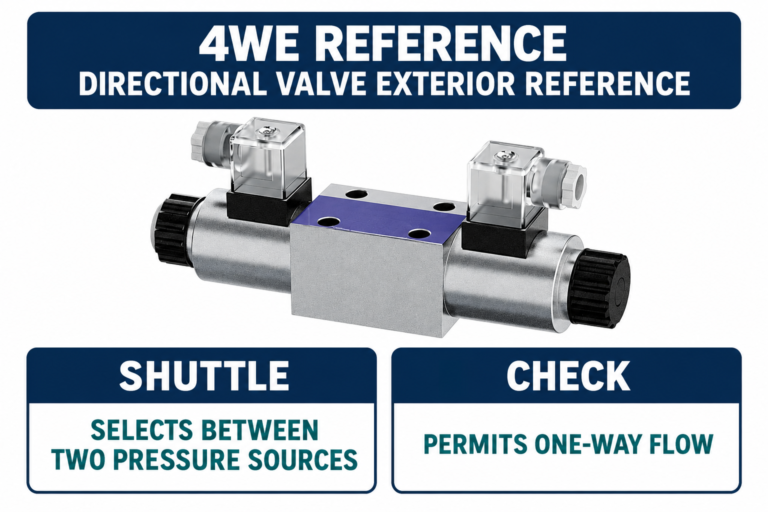
The Variable Displacement Pump OEM A10VO 31 Series catalog exterior is used as the real product reference in these explanatory images. It does not establish the approved service method, optional construction, or operating limits for an individual order. Confirm the complete code and its documentation. Related resources: Bomba de Deslocamento Variável OEM Série A10VO 31, gama de bombas hidráulicas, Lista de Verificação para Substituição de Bombas Hidráulicas: 15 Especificações a Cruzar, Relatório de Ensaio de Fábrica da Bomba Hidráulica: Como Ler os Resultados, Como devem os compradores controlar a contaminação num sistema de bomba hidráulica?.
Sources and limits of this guide
The university resource supports the component operating principles. NIOSH supplies hazardous-energy prevention context; exact machine isolation and component service requirements still need their approved procedures. NASA supplies a general maintenance decision framework, not hydraulic repair prices or component acceptance limits.
- NPTEL: Fundamentos de Hidráulica e Pneumática Industrial
- NIOSH: prevenção de lesões causadas por energia perigosa
- NASA: Reliability-Centered Maintenance Guide
University lesson: operating principles
NPTEL IIT Guwahati presents Lec 31: Flow control and pressure relief valves. The lesson supports the pump operating principles used in the engineering discussion; it is not a model-specific repair, storage, or installation approval.