Wenzhou Prance Hydraulic Equipment Co., Ltd

Suction Strainer vs Return Filter: Protecting a Pump Without Starving It
A hydraulic pump inlet strainer vs return filter decision starts with two different jobs. An inlet strainer intercepts coarse debris before it reaches the pump, but its pressure loss consumes the pump’s available inlet pressure. A return filter removes contamination from returning oil before that oil re-enters the reservoir. It does not protect the pump from everything already in the tank. The correct arrangement depends on the pump’s documented inlet limits, fluid viscosity, contamination sources and the complete circuit. Choosing finer inlet filtration simply because it sounds more protective can create an avoidable starvation problem.
This guide compares filtration locations rather than selecting a filter element or prescribing a universal micron rating. The external gear pump shown in the illustrations is a product reference. Its exterior does not establish approved inlet conditions, allowable vacuum or a suitable strainer for an individual installation.
Start with the contamination route
Ask how contamination can reach the pump. Assembly debris left in the reservoir, dirty replacement oil and particles entering through an inadequate breather can arrive upstream of a return filter. Wear particles generated in actuators or valves may travel through the return line. Material introduced during maintenance can enter at several different points. Each route suggests a different prevention measure; adding a filter at one location cannot cover every route.
Reservoir cleaning, controlled oil transfer, sealed storage and an appropriate breather remain important even when a return filter is installed. A coarse inlet screen cannot make dirty commissioning acceptable. Likewise, a return filter cannot correct an open filler neck or debris left downstream of the element. Identify the contamination source before buying a finer replacement element.
What an inlet strainer changes
An inlet strainer sits in the flow path feeding the pump. Its possible benefit is interception of relatively large material before that material enters the pumping elements. Its cost is additional resistance at a location where the available pressure margin may already be limited. The line, fittings, elevation and entrance geometry also consume that margin.
Cold oil, a loaded screen or increased pump speed can increase inlet restriction. If inlet pressure falls outside the pump’s approved conditions, noise, incomplete filling and damage may follow. Air ingress can produce similar symptoms, so sound alone does not identify a blocked strainer. Diagnose the inlet system using approved measurements and inspection rather than treating every noisy start as cavitation.
The word “strainer” also does not specify a performance class. Mesh opening, effective area, construction, bypass behavior and pressure-loss data matter. A part that physically fits the connection may still be unsuitable. Confirm the pump manufacturer’s recommendation before adding, removing or changing an inlet device.
What a return filter changes
A return filter processes oil coming back from the circuit. Because it is outside the pump inlet line, its pressure loss does not directly subtract from the pump’s inlet pressure budget. That makes it useful for contamination control without placing the same restriction immediately before the pump. However, its own backpressure still affects the equipment returning through it.
Return flow can exceed pump flow in some operating conditions. During retraction of a single-rod cylinder, for example, oil leaving the larger cap-end area can produce a higher return flow than the pump flow entering the rod-end area. Several simultaneous functions and accumulator discharge can create additional peaks. Size from the actual return-flow envelope, not automatically from the pump’s nominal delivery.
Check the housing, element, indicator and bypass arrangement together. A bypass can preserve a flow route while allowing oil to avoid the element; it does not mean filtration continues unchanged. An indicator must also be interpreted at its specified operating condition. Cold-start indication and warm-running loading are different observations, not interchangeable proof of element condition.
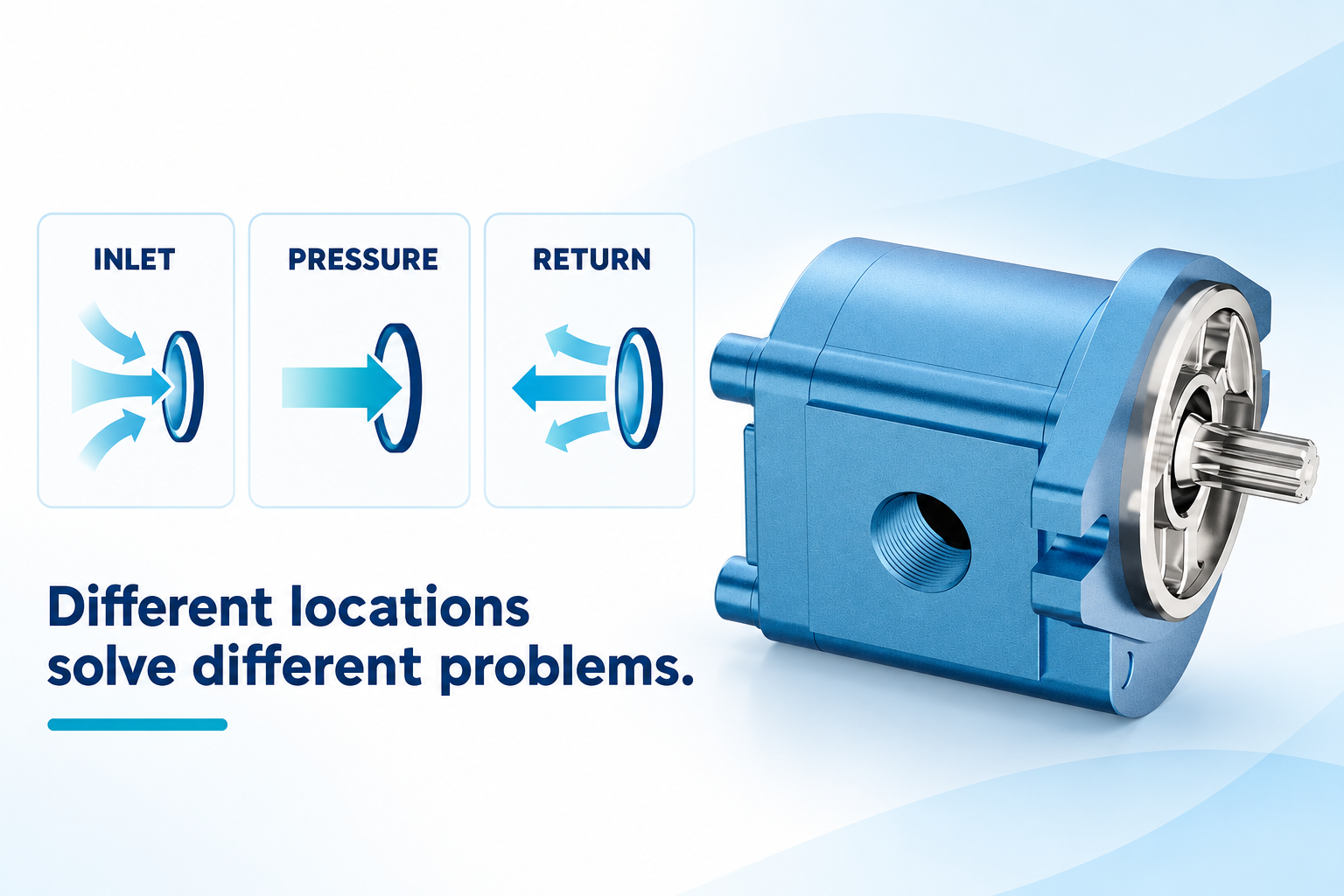
Compare the locations without confusing their jobs
The qualitative comparison below follows the operating principles discussed in the linked university hydraulics course and the general safety scope of ISO 4413. It gives decision criteria, not numerical acceptance limits. Use the selected component’s current documentation for those limits.
| Location | Main purpose | Pressure consequence to check | Limitação importante |
|---|---|---|---|
| Pump inlet strainer | Intercept coarse upstream debris | Added inlet restriction under cold and loaded conditions | Cannot replace reservoir cleanliness or fine contamination control |
| Return-line filter | Clean oil before it returns to the reservoir | Backpressure at peak return flow and cold viscosity | Cannot catch every contaminant already upstream of the pump |
| Pressure-line filter | Protect selected downstream components | Housing pressure rating and differential pressure | Pump-generated debris reaches this filter only after passing through the pump |
| Offline filtration | Improve reservoir oil condition on a separate circuit | Dedicated circuit flow and compatibility | Does not guarantee immediate protection from a sudden local contamination event |
Pressure filtration or offline filtration may complement a return filter, depending on the machine. None should be added solely from this table. Review the circuit, duty, cleanliness objective and maintenance arrangements as one system.
Build an inlet pressure budget
Use a consistent reference when checking inlet pressure. A gauge reading relative to local atmosphere and an absolute-pressure limit cannot be compared directly without conversion. Altitude, reservoir pressurization and the measuring location also affect interpretation. Record the instrument type and units with every reading so the result can be checked against the pump documentation.
Conceptually, pressure available at the pump inlet starts with pressure above the reservoir oil and the static contribution from the oil level. Losses through the entrance, line, fittings and any strainer reduce what reaches the inlet. This is a bookkeeping framework, not a complete transient calculation. Acceleration, aeration, viscosity and the pump’s filling behavior may require additional engineering review.
Consider a purely illustrative pressure-loss comparison: if a clean inlet device loses 0.05 bar at one operating condition and another loses 0.15 bar at that same condition, the second consumes an additional 0.10 bar of inlet margin. Those numbers are arithmetic examples only. They are not allowable values for the pictured pump, and they say nothing about performance with cold oil or a contaminated element.
The practical question is whether the worst credible operating condition still meets the approved inlet limit. A favorable reading with warm oil, a full reservoir and a new screen is insufficient if the machine must start cold at a lower oil level and higher speed.
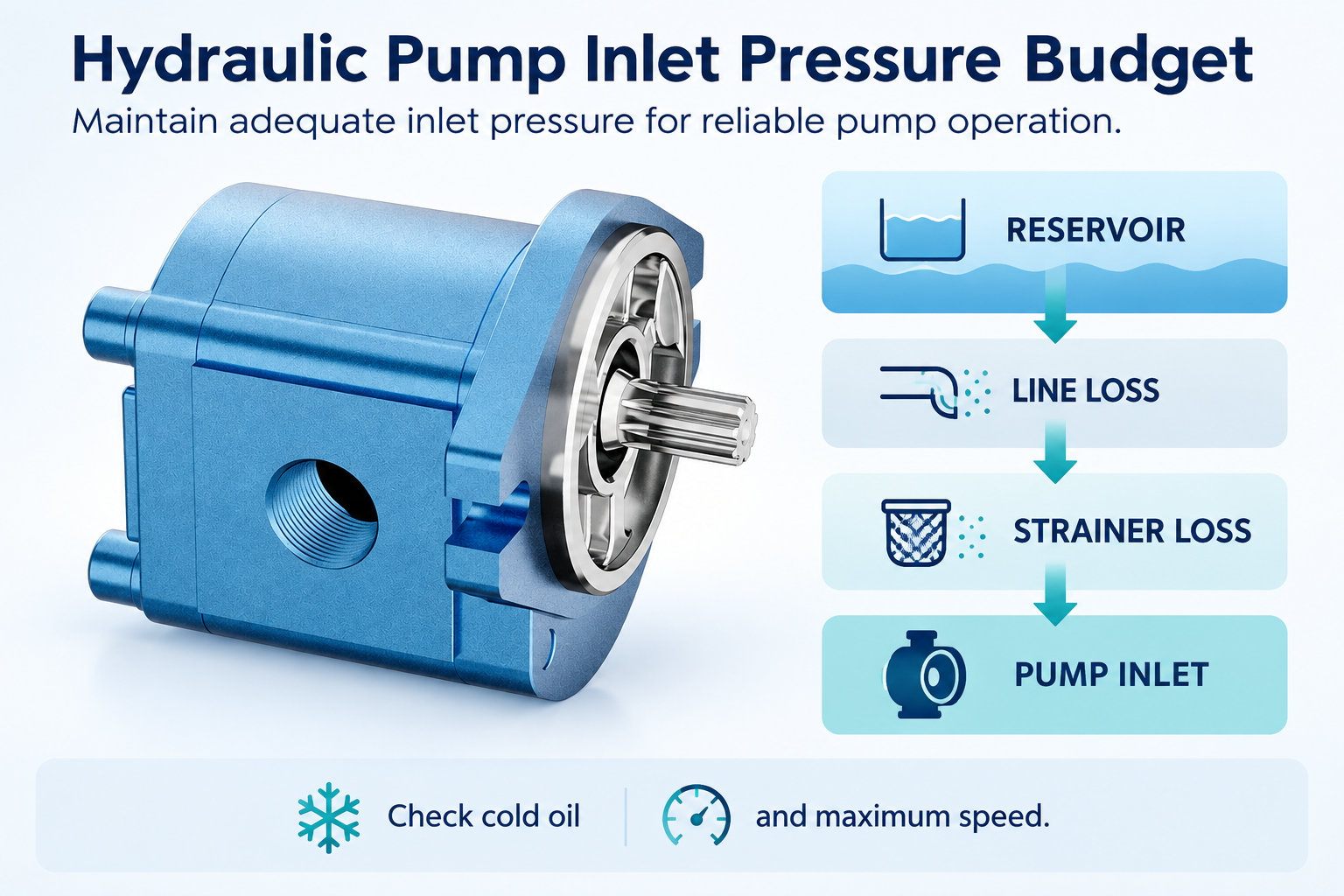
Check cold oil before changing filtration
Obtain the fluid grade and the actual starting-temperature range. Use the fluid supplier’s viscosity information rather than assuming all hydraulic oils behave alike. Compare the element’s pressure-loss data at relevant viscosity and flow, including any correction method specified by its supplier. A catalog curve at a different test condition is not a direct machine prediction.
Review the start procedure as well. A machine that starts at high speed or immediately applies demanding motion can have a different inlet requirement from one with an approved warm-up sequence. Do not invent a warm-up speed or duration. Follow the equipment instructions and verify the effect with suitable instrumentation where authorized.
Check whether the restriction is actually caused by the strainer. A collapsed hose, undersized fitting, closed isolation valve or obstructed tank entrance may dominate the loss. Replacing a screen with a coarser one can hide the symptom while leaving the underlying restriction unresolved.
Make a maintenance comparison that operators can use
Maintenance access matters because an inaccessible strainer may remain untouched until the pump becomes noisy. Determine whether inspection requires draining the reservoir, disturbing a suction connection or exposing clean surfaces. Include contamination control during reassembly. A service step that introduces dirt can undo the intended protection.
For a return filter, record element identification, approved replacement criteria, indicator instructions and the required seals. The schedule should account for commissioning debris and the real duty cycle. Avoid treating a fixed calendar interval as proof that an element is clean, or an indicator alone as proof that the entire oil system meets its cleanliness objective.
Keep suction leaks in view after service. An inlet connection may admit air without producing an obvious external oil leak. If noise or unstable operation follows maintenance, inspect the work area and sealing arrangements before assuming the new element is defective. Isolate hazardous energy before opening any part of the system.
Decide what to request from the supplier
A useful inquiry includes the complete pump code, approved inlet-pressure requirement, fluid identity, cold-start temperature, maximum speed and inlet-line arrangement. Add reservoir oil-level range, expected duty and the proposed filtration location. For the return side, include peak return flow, permissible backpressure and any case drains that must remain separate.
Ask for pressure-loss information under the stated conditions and an explanation of bypass and indicator behavior. Confirm whether the recommendation assumes a clean element only or includes an end-of-service condition. Request the document revision and the assumptions behind the selection so a future replacement can be checked properly.
The decision should produce a defined contamination-control arrangement and an inlet-pressure verification plan. It should not end with a vague instruction to fit “the finest filter possible.” Protecting a pump requires both clean oil and conditions that allow its chambers to fill.
Perguntas frequentes
Is a suction strainer always necessary?
No. Follow the pump and machine requirements. Its benefit in intercepting coarse debris must be weighed against inlet restriction, reservoir cleanliness, maintenance access and the complete contamination-control design. Do not remove an installed device without reviewing why the original system requires it.
Can a return filter replace an inlet strainer?
They work at different locations. A return filter can support reservoir cleanliness, but it cannot immediately intercept all material already between the reservoir and pump. Whether the inlet device can be omitted is a system design decision requiring the pump’s approved conditions.
Does a smaller micron number mean better pump protection?
Not by itself. Removal performance, capacity and pressure loss matter alongside the location. Finer inlet filtration can be harmful if it reduces inlet pressure beyond the approved limit. Confirm the element’s actual performance data instead of selecting from a label alone.
Should a return filter be sized from pump flow?
Use the maximum credible return flow. Cylinder area ratios, simultaneous functions and accumulator discharge can make return flow different from pump delivery. Verify the full operating envelope and the backpressure permitted by connected equipment.
What should be checked after changing an inlet strainer?
Check identification, cleanliness, sealing, reservoir level and the authorized start procedure. Where approved, verify inlet pressure under relevant temperature and speed conditions. Investigate new noise or unstable operation without reaching into or opening an energized system.
Produtos e recursos de engenharia relacionados
The External Gear Pump HDH catalog exterior is used as the real product reference in these explanatory images. It does not establish the approved service method, optional construction, or operating limits for an individual order. Confirm the complete code and its documentation. Related resources: Bomba de Engrenagens Externas HDH, gama de bombas hidráulicas, O que os compradores devem recolher antes de comparar a taxa beta de um filtro hidráulico, Velocidade Máxima da Bomba Hidráulica: Condições de Admissão e Compromissos na Vida Útil.
Sources and limits of this guide
The university resource supports the component operating principles. NIOSH supplies hazardous-energy prevention context; exact machine isolation and component service requirements still need their approved procedures. Sources explain general operating principles, not performance ratings or optional features of the pictured catalog component.
- NPTEL Industrial Hydraulics: hydraulic accessories, hoses, filters and coolers
- NIOSH: prevenção de lesões causadas por energia perigosa
- DIN Media: DIN EN ISO 4413, hydraulic fluid power safety (standard overview)
University lesson: operating principles
NPTEL IIT Kharagpur presents Lecture 39 : Hoses, Filters and Coolers. The lesson supports the pump operating principles used in the engineering discussion; it is not a model-specific repair, storage, or installation approval.