Wenzhou Prance Hydraulic Equipment Co., Ltd

Swash Plate Pump Working Principle: From Rotation to Variable Flow
The swash plate pump working principle converts shaft rotation into repeated axial piston strokes. A cylinder barrel rotates with the drive shaft while several pistons slide in bores parallel to that shaft. Each piston is connected through a slipper to a stationary inclined plate. As the barrel turns, the slipper follows the plate, so the piston retracts through one half-turn and advances through the other. The growing chamber draws oil through the inlet kidney port; the shrinking chamber pushes oil through the outlet kidney port. A greater swash plate angle creates a longer stroke and more displacement per revolution. Reducing the angle reduces flow, and crossing neutral can reverse flow in designs built for over-center operation.
Main parts that make the pumping cycle possible
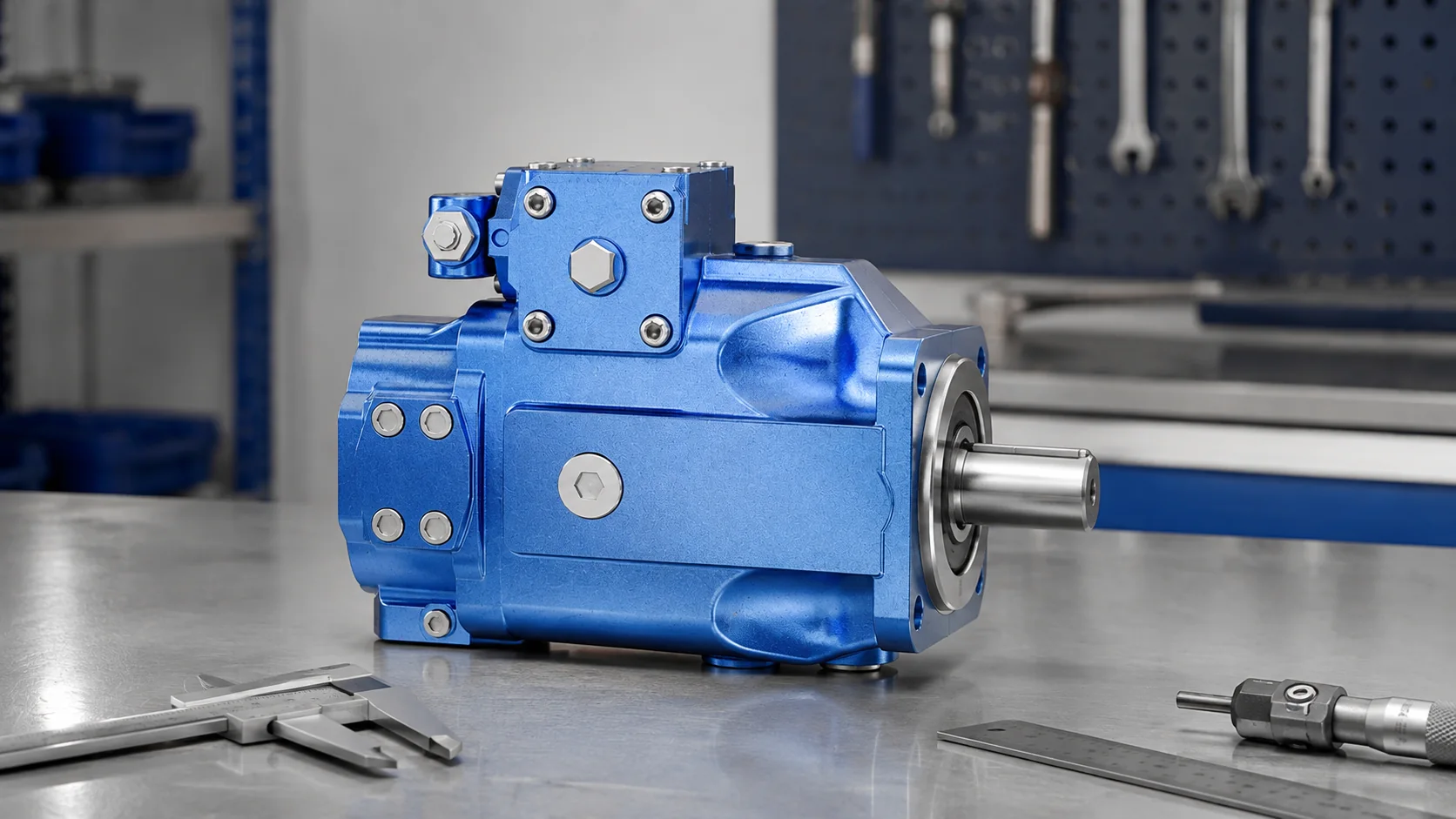
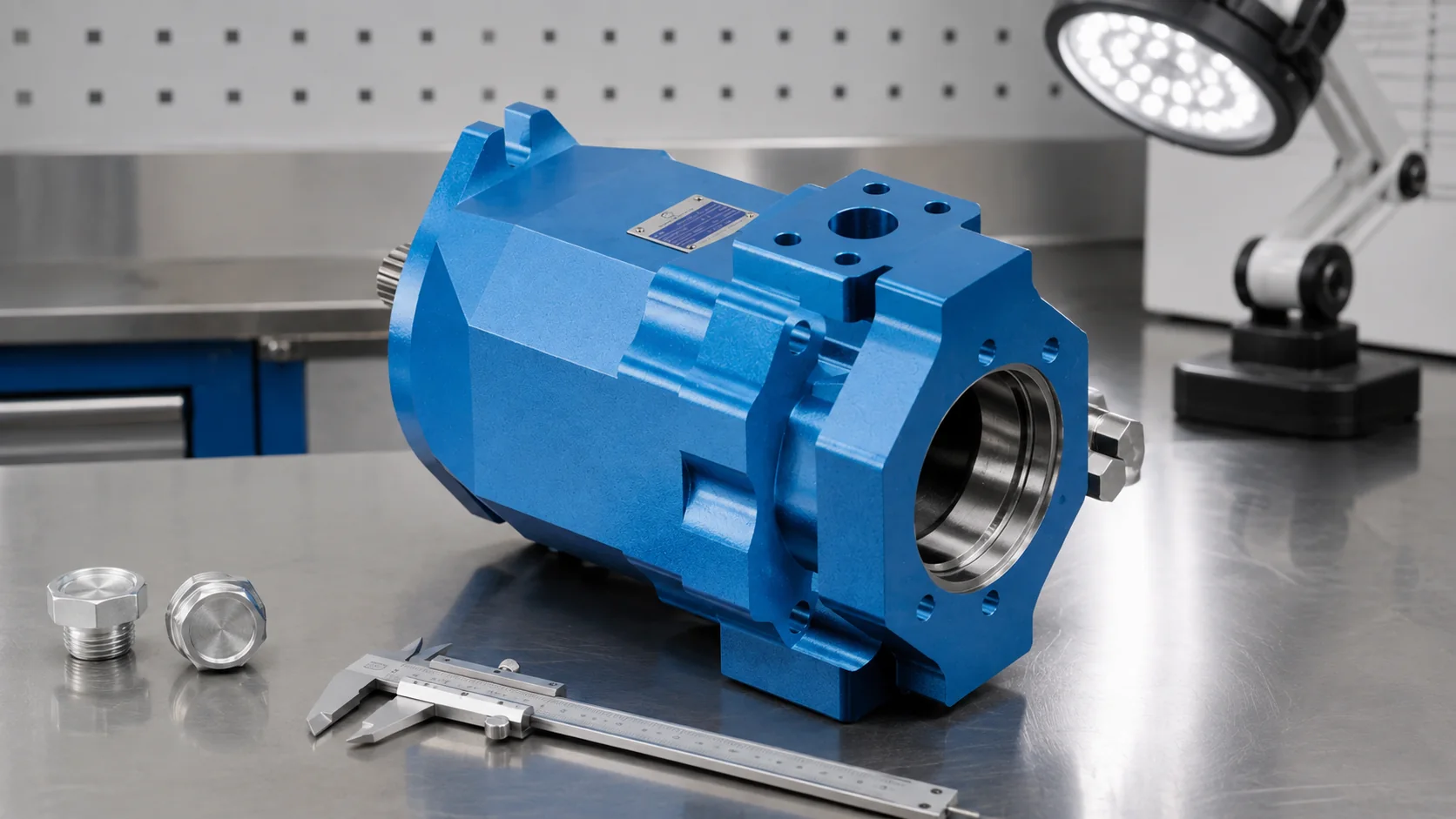
The rotating group normally includes the shaft, cylinder barrel, pistons, slippers, retainer mechanism, and often a spring or preload arrangement. The valve plate sits against the barrel face and contains inlet and outlet port windows. The swash plate, or yoke in some variable designs, establishes the geometric stroke. Bearings support shaft and control loads, while the housing collects internal leakage and routes it through the case drain.
These parts form a matched system. The barrel-to-valve-plate interface must separate high- and low-pressure zones while maintaining a lubricating film. The slippers must remain against the swash plate without excessive contact stress. The case must stay filled and drained within the limits defined for the exact model. Generic diagrams explain motion, but clearances, preload, permissible case pressure, and control settings must come from the manufacturer.
The port plate also times communication between each piston bore and the main ports. Its transition geometry affects compression, decompression, noise, and pressure ripple, so a visually similar plate is not automatically an acceptable substitute.
Step-by-step pumping cycle
- The shaft turns the cylinder barrel. The pistons rotate around the shaft axis with the barrel.
- The slippers follow the inclined surface. Because the plate is not perpendicular to the shaft, each slipper moves closer to and farther from the barrel during a revolution.
- One chamber expands. The corresponding piston withdraws, increasing its bore volume while the barrel port passes over the inlet window.
- The chamber crosses a transition zone. The valve plate separates inlet and outlet ports. Relief grooves or timing features may manage decompression and pressure transition, but their form is model-specific.
- The chamber contracts. The piston advances while its barrel port aligns with the outlet window, displacing oil into the pressure port.
- The sequence overlaps around the barrel. Multiple pistons at different phases create a more continuous outlet flow than one piston could provide alone.
The New York University engineering teaching material on hydraulic and pneumatic actuators describes a positive-displacement pump as drawing in and expelling a fixed amount per shaft revolution. The swash plate mechanism is one way to create that repeated volume change.
How angle changes displacement and flow
At a fixed nonzero angle, the piston stroke is fixed, so the pump is fixed displacement. In a variable pump, a control piston or servo mechanism changes yoke angle. Theoretical flow remains displacement per revolution multiplied by rotational speed. Actual flow is lower because some oil is required for lubrication and some crosses internal clearances. As pressure differential, wear, or temperature changes, the relationship between theoretical and delivered flow also changes.
At approximately zero angle, piston stroke and main-port flow approach zero, although internal leakage and control flow can remain. In an over-center closed-loop unit, moving the plate to the opposite side changes which port receives displacement flow. Do not assume every variable axial piston pump can cross center; many open-circuit pumps operate only on one side of neutral.
| Swash plate condition | Piston stroke | Expected main effect | Verification needed |
|---|---|---|---|
| Fixed positive angle | Constant geometric stroke | Flow follows speed, subject to leakage | Rated displacement and direction |
| Variable positive angle | Adjustable from small to maximum | Control changes displacement and flow | Control type, minimum angle, response |
| Near neutral | Very small | Main flow approaches zero | Control flow, leakage, case cooling |
| Negative angle in over-center design | Stroke reverses phase | Flow direction reverses between main ports | Closed-loop rating and charge circuit |
Fixed and variable swash plate pumps
A fixed unit uses a nonadjustable plate angle and is mechanically simpler. Circuit valves must manage excess flow whenever actuator demand is lower than pump delivery. A variable unit can change displacement to match system demand. Common control concepts include manual displacement control, pressure compensation, load sensing, electrical proportional control, and power or torque limiting. The name of a control does not define its setting, dynamic response, or external connections; those details are model-specific.
Pressure compensation reduces displacement as outlet pressure approaches a set value. Load-sensing control responds to a signal representing load pressure and typically maintains a pressure margin across a metering element. Power control reduces displacement as pressure rises to limit the drive torque or power demand. These functions can be combined, which is why the complete model code and hydraulic diagram are essential during replacement.
Swash plate versus bent-axis piston pump
Both are axial piston machines, but their geometry differs. In a swash plate design, the cylinder barrel and shaft are generally coaxial, and piston slippers follow an inclined plate. In a bent-axis design, the cylinder barrel axis is angled relative to the drive shaft, and the piston connection follows that bent geometry. The two families are not interchangeable merely because displacement and pressure appear similar.
Compare mounting flange, shaft, port arrangement, rotation, operating circuit, displacement range, control behavior, case drain requirements, speed limits, and external dimensions. Prance Hydraulic’s piston pump product family includes different axial-piston configurations, while the hydraulic pump overview places piston pumps alongside gear and vane alternatives.
Why case drain and inlet conditions matter
Internal leakage lubricates and cools interfaces before returning through the housing drain. Excessive case pressure can load shaft seals, disturb rotating-group balance, or indicate a restricted drain. The drain line must follow the exact installation instructions for size, routing, allowable pressure, and housing-fill procedure. Case-drain flow can be useful diagnostic evidence, but only when measured at a defined oil temperature, pressure, speed, displacement command, and test duration.
On the inlet side, inadequate absolute pressure can cause cavitation, aeration, noise, loss of lubrication, and surface damage. Oil viscosity, line size, filter condition, reservoir level, elevation, temperature, and shaft speed all influence inlet conditions. Review our complementary guides to hydraulic pump inlet conditions, pump cavitation prevention, and case-drain checks.
Common failure evidence and what it does not prove
Scoring on a valve plate, barrel face, slipper, or swash plate is important evidence, but the mark alone does not identify the root cause. Contamination, inadequate inlet conditions, insufficient case fill, excessive case pressure, wrong fluid viscosity, overload, misalignment, or an unsuitable replacement can create overlapping symptoms. Keep the failed parts, oil sample, filter evidence, operating records, and circuit settings together.
Before disassembly, record speed, pressure, displacement command, temperature, noise condition, delivered flow, case-drain behavior, and control signals. After disassembly, check patterns across mating surfaces rather than treating one damaged component in isolation. A replacement installed without correcting the circuit cause may fail in the same way.
Selection and RFQ checklist
- Open or closed circuit and required flow direction
- Displacement, adjustment range, and target flow at drive speed
- Continuous, intermittent, and peak pressure requirements
- Minimum and maximum shaft speed, rotation, and drive power
- Control type, control pressure, electrical details, and fail behavior
- Mounting flange, shaft, ports, through-drive, and installation envelope
- Fluid type, viscosity range, temperature, cleanliness, and inlet condition
- Case-drain routing, allowable case pressure, housing orientation, and fill procedure
- Duty cycle, load transients, ambient conditions, and application description
- Existing model code, serial data, photographs, and circuit diagram
Indiana’s fluid-power training overview emphasizes interpreting hydraulic specifications and systematic fault finding; see the Fundamentals of Fluid Power—Hydraulics credential summary. For procurement, use the exact manufacturer data rather than a generic cross-reference.
Educational video: axial piston pump motion

Open the educational animation on YouTube. Use it to visualize motion, then verify all practical limits in the applicable data sheet.
FAQ
What does the swash plate do in a hydraulic pump?
It sets the axial stroke of pistons rotating in the cylinder barrel. That stroke creates expanding inlet chambers and contracting outlet chambers.
Does a larger swash plate angle increase flow?
Within a pump’s designed range, a larger angle increases piston stroke and displacement per revolution. Actual flow still depends on speed, leakage, control behavior, and operating conditions.
Can every swash plate pump reverse flow?
No. Only designs intended to move through neutral and over center can reverse displacement direction. Many open-circuit variable pumps remain on one side of neutral.
Why does an axial piston pump need a case drain?
The housing collects internal leakage used for lubrication and cooling. The drain returns that oil while controlling housing pressure according to the manufacturer’s installation limits.
Is a swash plate pump the same as a bent-axis pump?
No. Both use axial pistons, but their shaft, barrel, and piston geometries differ, affecting mounting, speed, controls, and application fit.