Wenzhou Prance Hydraulic Equipment Co., Ltd

Hydraulic Motor Storage: Preservation, Inspection, and Return to Service
Hydraulic motor storage should preserve the condition of an identified, uninstalled spare until it can be released for service under the correct product instructions. Keep its hydraulic and mechanical interfaces protected, prevent unsuitable environmental exposure, preserve its identity and treatment history, and inspect it before installation. There is no single storage duration, shaft-turning interval, or internal filling method that is correct for every motor. Follow the instructions for the exact configuration, fluid, seals, and preservation treatment rather than applying a generic spare-parts rule.
An undamaged package is useful evidence, but it is not proof that a motor is ready to run. This guide separates preservation during storage from the installation and controlled startup work needed when the spare is finally used.
Identify the spare before defining its storage method
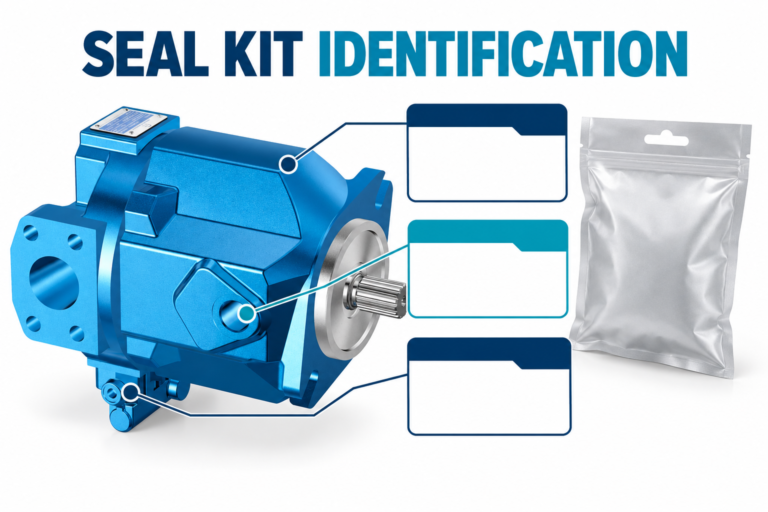
Record the complete product code, serial or other traceability reference, supplied options, receiving date, and relevant documents. A basic series name is not enough where shaft arrangement, port function, seals, brake features, or controls differ. Keep this information linked to the actual physical unit, not only to a warehouse bin that might later hold another item.
The record should identify whether the motor is new, repaired, previously installed, or removed following a fault. These conditions do not have the same preservation starting point. A returned motor with unknown fluid and open ports should not be placed directly into the available-spares category merely because its outside has been cleaned. Separate uncertain material until its condition and intended treatment have been reviewed.
Confirm the supplier’s preservation boundary
Ask what protection was applied before shipment and what conditions it assumes. Determine whether the motor contains a compatible preservation fluid, residual test fluid, another treatment, or no specified internal preservation. Do not infer the internal state from oil visible at a port. A small amount of fluid does not establish the treatment’s identity or duration.
The instructions should also clarify what the user may inspect or renew without compromising the protection. Opening the package to photograph a nameplate can have different implications from removing hydraulic closures or rotating the shaft. If the required preservation information is absent, obtain clarification before inventing a fill, draining, or periodic rotation procedure. Record the eventual instruction against that unit so the same uncertainty does not return at the next inspection.
Choose an environment the package can actually protect against
Use an indoor storage arrangement suitable for the product and its packaging. Control exposure to water, condensation, dust, corrosive substances, excessive heat, and other conditions identified by the supplier. A covered outdoor pallet is not equivalent to a controlled spare-parts area. Environmental swings can matter even when rain never touches the motor.
Do not publish a universal warehouse temperature or humidity limit unless it comes from the applicable documentation. The point is to match the product’s requirements with the conditions that can be demonstrated. Where monitoring is required, retain the records. If a significant excursion occurs, flag affected stock for review rather than resetting the receiving date and assuming the original protection still applies.
Support the body and protect the interfaces
A storage cradle should support the motor in a way approved for its mass and geometry. Do not rest the assembly on a vulnerable shaft, connector, brake fitting, or hydraulic port. Prevent the unit from rolling, falling, or receiving impact during ordinary warehouse handling. Keep lifting and handling requirements visible for staff who may not recognize the component.
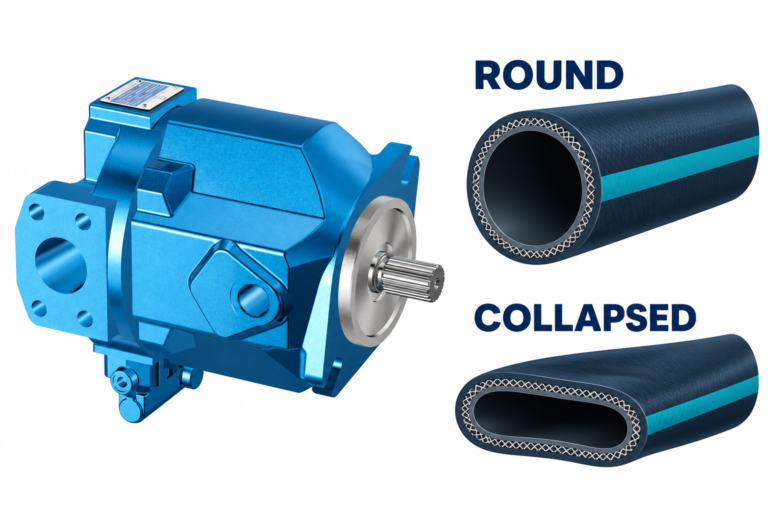
Protect the shaft and mounting interfaces against corrosion and mechanical damage using the specified method. The protection must not introduce abrasive contamination, incompatible chemicals, or damaging loads. A tightly wound cover is not a substitute for correct support. The real catalog motor shown in the illustrations establishes the exterior reference only; the illustrated cabinet is not an approved packaging drawing for every configuration.
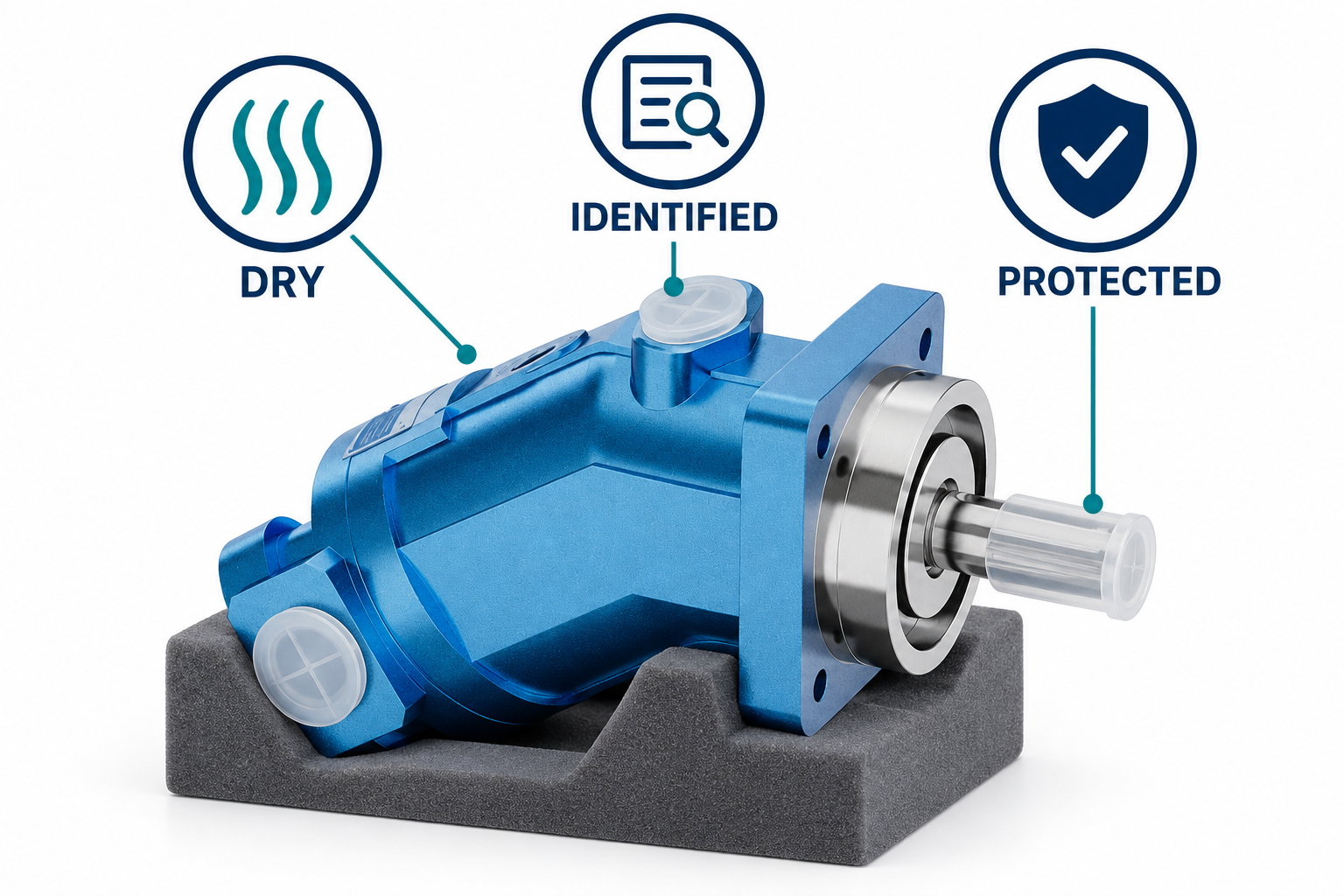
Keep hydraulic openings closed and identifiable
Closures should prevent contamination entering through hydraulic connections during storage and handling. Use suitable clean protective devices and retain identification of the ports where supplied. A rag, loose tape fragment, or unknown used cap can introduce material that is difficult to detect later. Avoid treating a shipping plug as an operating component unless its intended use is confirmed.
When a closure must be removed, control the work area and restore protection promptly under the applicable procedure. Record unusual findings such as water, debris, corrosion, damaged threads, or missing closure parts. Do not conceal a compromised opening by fitting a new cap and returning the motor to available stock without reviewing possible internal exposure.
Manage shaft movement and internal fluid by instruction
Some products or preservation arrangements may specify actions during extended storage, but those actions are not interchangeable between motor types. Shaft movement can affect internal fluid distribution, seals, braking arrangements, or other features. Forcing a shaft that does not move freely can create damage or expose a misunderstood brake condition.
Similarly, indiscriminate filling is not a safe universal preservation method. The correct fluid, filling location, allowable internal condition, orientation, and any expansion considerations depend on the assembly. Do not use the reservoir oil from an unrelated machine merely because both products are hydraulic. If the manufacturer or approved service provider specifies an inspection or renewal interval, record completion and findings rather than merely ticking a calendar date.
Use a practical stock-condition table
| Storage observation | Appropriate stock status | Next action |
|---|---|---|
| Identity, packaging, and history remain traceable | Retain within the approved storage system | Continue specified inspections and record conditions |
| Missing product or preservation information | Hold pending identification | Obtain the correct documentation before release |
| Open or damaged hydraulic closure | Hold for exposure assessment | Review contamination and restore protection under instruction |
| Water, corrosion, impact, or significant environmental excursion | Hold for competent inspection | Assess affected interfaces and possible internal condition |
| Unit removed after a fault | Separate from service-ready spares | Diagnose, repair, and test as required before reclassification |
| Ready to install after storage | Release only against current requirements | Complete identity, condition, compatibility, and startup checks |
This qualitative table is a warehouse decision aid. It does not specify an acceptable corrosion level or extend a manufacturer’s storage period.
Treat elastomers as part of the assembly, not a calendar alone
Seals may be affected by material, packaging, previous service, fluid exposure, and storage conditions. ISO 2230:2026 describes a framework for storage, inspection, recording, and packaging of rubber products and components. Its published scope does not establish one expiry date for a complete hydraulic motor, and it should not be presented as approval to install an assembly solely because a calculated seal age appears acceptable.
Keep seal material or configuration information with the motor record where available. If storage history is uncertain, a qualified review may be needed before release. Replacing external seals without assessing the rest of an exposed assembly is not proof that its internal condition has been restored. Use the applicable component instructions to decide what inspection or service is needed.
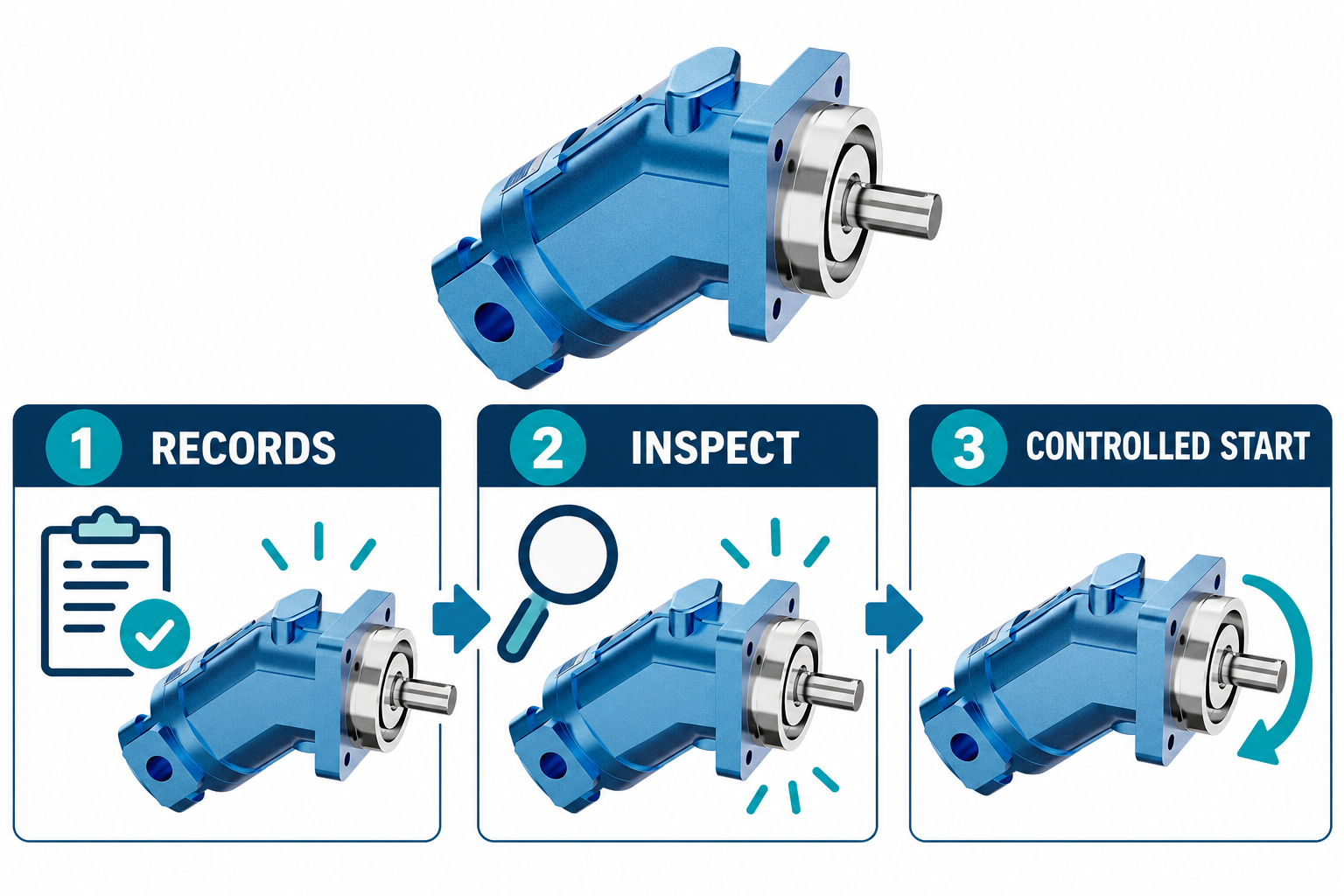
Inspect before opening the installation job
Before moving the spare to the machine, compare its complete identity with the current requirement. The machine may have changed since the spare was purchased. Review mounting, shaft, hydraulic functions, fluid compatibility, controls, and any braking arrangement. A preserved spare can still be the wrong configuration for the current machine.
Inspect packaging and visible interfaces before removing protection. Look for damaged closures, corrosion, impacts, unreadable identity, and evidence of leakage or contamination. Compare these observations with the receiving and storage records. If a discrepancy is found, resolve it before the planned outage depends on that motor. This is particularly important when the spare has been transferred between warehouses or held after a repair.
Return to service through the approved sequence
Prepare the machine under its energy-control and installation procedures. Stored hydraulic, gravitational, or mechanical energy may remain even after the prime mover is stopped. Confirm safe restraint of the driven load before connecting or handling the motor, and do not use an uncontrolled rotation attempt as a condition check.
Remove preservation materials and prepare internal fluid conditions only as instructed. Verify required drains, connections, filling, and control arrangements for the specific motor. Use a staged startup that records the relevant pressure, flow, speed, temperature, leakage, and load observations. Preserve the storage record with commissioning results so that a later issue can be investigated using the actual history rather than assumptions about how long the motor sat on a shelf.
Frequently asked questions
Can every stored hydraulic motor be filled completely with oil?
No universal filling instruction is appropriate. Confirm the required fluid, internal preservation method, connections, orientation, and preparation for service with the applicable documentation. An unsuitable treatment can create contamination or incompatibility instead of protection.
Should the shaft be turned every month?
Use the interval and method specified for the exact motor and preservation arrangement, if such an action is required. A generic monthly rule can conflict with a brake, internal condition, or supplier instruction. Do not force an unidentified assembly.
Does sealed packaging prove the motor is usable?
It helps preserve and document condition but does not establish correct configuration, absence of hidden damage, or readiness for startup. Review identity, storage history, visible condition, and the required release procedure before installing the spare.
Can a repaired motor use the original new-unit storage record?
Keep the original identity, but add the repair and subsequent preservation record. Repaired, tested, and re-preserved condition must be traceable to the actual work. Do not erase the earlier history by treating the repair date as a new manufacturing date.
What is the most useful warehouse improvement?
Separate service-ready stock from items awaiting identification, exposure assessment, or repair. Connect every physical motor with its documentation and condition status. This prevents an uncertain component from becoming an emergency spare simply because it is present on the shelf.
Product and related engineering resources
The Fixed Displacement Motor A2FM catalog exterior is used as the real product reference in these explanatory images. It does not establish the approved service method, optional construction, or operating limits for an individual order. Confirm the complete code and its documentation. Related resources: Fixed Displacement Motor A2FM, hydraulic motor range, Hydraulic Motor Replacement Checklist for Mobile Equipment, Hydraulic Motor Shaft Seal Failure: Pressure, Alignment, and Wear, Which hydraulic motor mounting details need confirmation?.
Sources and limits of this guide
The university resource supports the component operating principles. NIOSH supplies hazardous-energy prevention context; exact machine isolation and component service requirements still need their approved procedures. ISO references identify the stated standard scope. This guide does not reproduce paid clauses or turn their abstract into model-specific limits.
- NPTEL: Fundamentals of Industrial Oil Hydraulics and Pneumatics
- NIOSH: preventing injuries from hazardous energy
- DIN Media official standards entry: ISO 2230:2026, Rubber products, guidelines for storage (scope; not an assembled-component expiry)
University lesson: operating principles
NPTEL-NOC IITM presents 6.3 – Hydraulic Motors. The lesson supports the motor operating principles used in the engineering discussion; it is not a model-specific repair, storage, or installation approval.