Wenzhou Prance Hydraulic Equipment Co., Ltd.

Hydraulic Motor Dry Running: Lubrication Loss and Inspection Priorities
Hydraulic motor dry running can damage lubricated interfaces when oil is missing, supply is interrupted, or an installation requires a filled housing that has not been prepared correctly. Stop a suspected event safely rather than running the motor again to see whether the noise disappears. Establish what lost lubrication, preserve the oil and debris evidence, and obtain the correct inspection and restart instructions for the exact motor. A brief event does not prove that the motor escaped damage, and a damaged motor does not always seize immediately.
This guide concentrates on loss of lubrication and the decision after an event. It does not replace a general bearing-failure investigation, authorize dismantling, or provide a universal filling procedure. The A2FM catalog exterior used in the illustrations identifies a real Prance product; it cannot show which internal surfaces were damaged or establish the preparation requirements of an individual order.
What dry running means in a hydraulic motor
The term is often used too loosely. A motor can experience interrupted working flow, an inadequately filled housing, air ingestion, loss of a required lubrication path, or shaft rotation driven by the machine while the intended oil supply is unavailable. These situations need different circuit investigations. Record which condition was actually observed instead of treating every unusual sound as proof of dry running.
Working-port oil and housing oil should not be assumed to have interchangeable functions. Different motor designs route leakage, cooling and lubrication differently. An external drain may be required on one arrangement and handled differently on another. Use the ordered motor’s installation drawing and operating instructions to identify those paths. Never infer a drain-port function from the appearance of a plug or a generic photograph.
A low reservoir level is a warning, but it does not by itself establish the duration or location of lubrication loss. Equally, a full reservoir does not establish that the motor housing was filled, a supply valve was open, or the machine maintained an acceptable inlet condition while coasting. The diagnostic question is whether the required oil reached the required interfaces under the actual motion and load.
Why lubrication loss can produce damage quickly
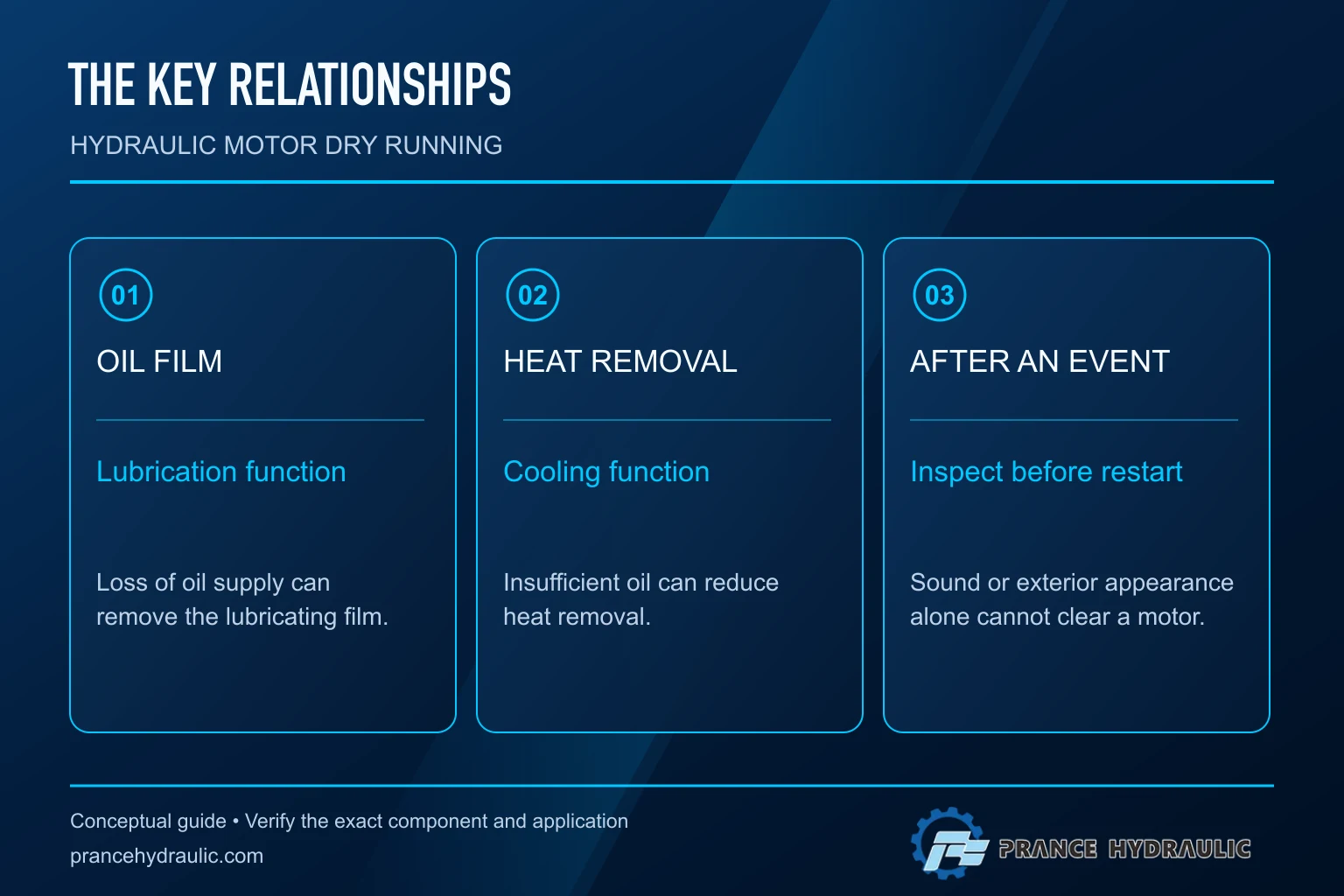
NPTEL’s hydraulic-fluid lesson describes lubrication and other fluid functions. Oil helps separate moving surfaces, remove heat and carry particles toward filtration. When an adequate film is not maintained, local friction can rise even before a housing temperature sensor shows a large change. Contact damage may begin at highly loaded interfaces while the exterior still feels ordinary. A cool housing after shutdown is therefore weak evidence about the condition during the event.
Frictional heating and wear can reinforce each other. Surface distress creates debris; debris can damage other interfaces or travel into the circuit; disturbed clearances can then change leakage and efficiency. A motor that still turns can nevertheless have reduced life or contaminate a replacement. Treat the whole connected circuit as part of the investigation rather than assuming that replacing the noisy component removes the cause.
Do not invent a safe exposure duration. Risk depends on the design, residual oil, speed, load, temperature and failure mode. An anecdote about another motor surviving a short run cannot establish a permissible dry-running time for yours. Where the event history is incomplete, keep that uncertainty visible in the inspection request.
First actions after a suspected event
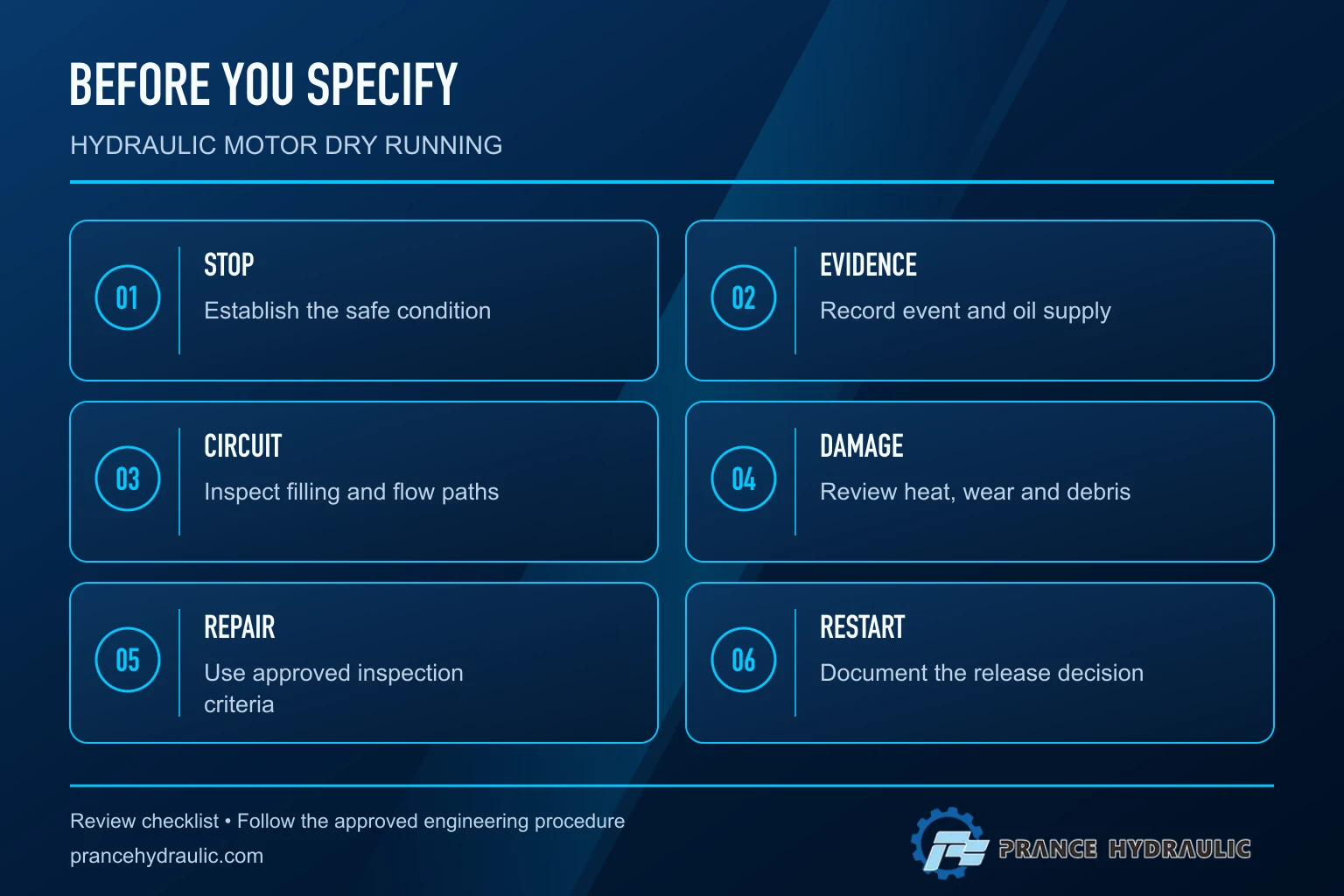
Bring the equipment to its approved safe state. Isolate power, secure suspended or driven loads, account for rotation and stored pressure, and apply the site’s hazardous-energy procedure. A motor can be driven by a descending load or rotating attachment after the prime mover has stopped. Do not loosen a fitting to discover whether pressure remains, and do not approach a rotating shaft for a sound comparison.
Preserve the evidence before draining or cleaning the assembly. Record the operating mode, approximate speed, load, commands, oil temperature, alarms and event sequence. Photograph leaks, reservoir condition, connected hoses and the complete product code. Save available controller trends with timestamps. Label observations as measured, operator-reported or inferred so the service team can distinguish facts from reconstruction.
Collect fluid or filter evidence through an approved sampling procedure after the equipment is safe. Do not cut a filter open casually beside an unprotected hydraulic assembly. Sampling location, cleanliness and handling affect the result. A contaminated container or material introduced during dismantling can make later particle identification misleading.
A practical investigation sequence
The table separates evidence from decisions. It gives no permission to energize a damaged drive or bypass protection.
| Frage | Nützliche Beweise | What it can establish | What it cannot establish alone |
|---|---|---|---|
| Was required oil available? | Level history, supply configuration, installation record | A plausible supply interruption or preparation omission | Exact internal damage |
| Was the shaft turning without normal supply? | Speed trend and machine motion history | A possible overrun or externally driven event | Adequacy of every lubrication path |
| Was air involved? | Oil condition, inlet measurements and leak inspection | An aeration or inlet-condition concern | Proof that all noise was cavitation |
| Has debris spread? | Properly obtained oil, filter and retained-part examination | Need for wider contamination assessment | Automatic condemnation of every component |
| Is the motor fit to restart? | Authorized inspection and documented acceptance | A supported service decision | A general safe dry-running time |
NPTEL’s hydraulic teaching supports the operating distinctions, NASA’s maintenance guidance supports evidence-based fault investigation, and NIOSH supports isolation of hazardous energy. Model-specific service limits still come from the equipment and motor documentation.
Inspect more than the motor exterior
Look for the initiating cause in the circuit and installation history. A maintenance change may have introduced a closed valve, incorrect hose route, omitted filling step, or unsuitable drain arrangement. A machine modification may allow the load to drive the motor during shutdown. A supply issue can recur at a particular attitude or oil level even though an idle inspection appears normal.
Inspect accessible external evidence without assuming that it reveals the internal result. Shaft-seal leakage, discoloration, unusual resistance or noise can justify escalation, but their absence does not clear the motor. Manual shaft rotation, when permitted and safely isolated, cannot reproduce operating load or measure loaded efficiency. Do not force a shaft or perform an improvised compressed-air rotation test.
Internal examination belongs to qualified personnel using the correct instructions and clean working practices. Preserve the orientation and condition of removed parts. Wear appearance should be interpreted with oil history, load and contamination data; photographs alone may not distinguish lubrication loss from misalignment, excessive shaft loading or pre-existing fatigue.
Distinguish dry running from similar symptoms
Aeration, cavitation, mechanical misalignment, overload and bearing damage can all create noise or temperature concerns. Several can occur together. A motor that becomes noisy after maintenance may have an air issue, an incorrect coupling position, a restrictive return route, or an unrelated load problem. Avoid choosing the first explanation that matches a sound description.
Compare the event sequence with measured conditions. If noise began as the load overran the drive during stopping, examine the approved make-up and braking arrangement. If it began immediately after a drained motor was installed, review preparation and filling requirements. If it developed gradually under a steady supply, investigate contamination, mechanical loading and wear as well. These are investigation branches, not automatic diagnoses.
Case-drain observations need particular care. Flow and pressure are different measurements, and routing varies by motor. An abnormal result can support further inspection but should not be compared with a universal number from an unrelated model. Do not block a drain or route it through a restrictive temporary instrument to make a quick measurement.
Restart requires a documented decision
Restoring the reservoir level is not the same as restoring serviceability. A restart plan should address the initiating cause, motor condition, connected-circuit cleanliness and required preparation. Where significant debris is found, the inspection scope may include lines, valves, filters and other components that shared the oil. Use the equipment’s contamination-control and commissioning procedures rather than assuming a new filter captures everything immediately.
Agree on the acceptance criteria before any controlled test. Define who may authorize the test, what conditions will be measured, the allowed operating envelope and the stop conditions. The motor’s documentation should determine filling, venting, minimum inlet conditions, drain arrangement and permissible starting procedure. No generic article can safely supply those values for an unidentified unit.
During an authorized test, record the same measurements consistently so trends can be compared. Temperature, speed, delivered flow, differential pressure, drain behavior and leakage may be relevant, but instrumentation must suit the circuit and pressure class. A short quiet run is one observation; it does not erase the earlier event or replace required inspection.
Information to send with a repair or replacement request
Provide the full model and order code, installation orientation, circuit drawing and photographs of the connected ports. Describe whether the shaft was driven hydraulically or mechanically when supply was lost. Include fluid identity, temperature history, maintenance changes and the approximate sequence from first symptom to isolation. State which measurements were taken and where the sensors were installed.
Ask the supplier to distinguish cause, observed damage and recommended corrective work. Request the inspection findings and any conditions attached to returning the unit to service. If replacement is necessary, confirm the original function and interface requirements rather than ordering solely by housing appearance. A visually similar motor may have different shaft, seals, porting, rotation or drain requirements.
For prevention, convert the findings into the existing commissioning and maintenance instructions. Useful controls can include verified preparation steps, recorded oil condition, correct drain routing and a reviewed response to loss-of-supply alarms. Any additional interlock or circuit change needs engineering validation. Adding a warning label without correcting the initiating condition leaves the same failure path open.
Häufig gestellte Fragen
Can a hydraulic motor run dry for a few seconds?
There is no general safe duration. Damage depends on the motor, retained oil, motion, load and temperature. Follow its approved instructions, and treat an unintended event as a reason for investigation rather than using a time estimate to clear the motor.
Does a motor need oil in its housing before starting?
Some designs and installations require specified housing preparation. Obtain the exact motor’s instructions, including orientation and port identification. Do not transfer a filling procedure from another design or assume working-port supply automatically satisfies it.
Does normal rotation prove the motor is undamaged?
No. A motor may rotate with damaged surfaces, changed clearances or reduced life. Rotation alone does not measure loaded efficiency or establish that contamination has remained inside the motor.
Should the oil and filters be changed immediately?
First preserve appropriate evidence and establish the contamination-control plan. Oil or filter replacement may be necessary, but it should follow the documented investigation and cleanup requirements rather than removing useful evidence or leaving contaminated sections untreated.
Can I restart after correcting a low oil level?
Only after the equipment is safe and the motor and circuit have been assessed under the applicable procedure. Correcting the level addresses one condition; it does not establish the cause, damage state, correct preparation or acceptance criteria.
Produktdaten und entsprechende technische Ressourcen
The Fixed Displacement Motor A2FM catalog exterior is used as the real product reference in these explanatory images. It does not establish the approved service method, optional construction, or operating limits for an individual order. Confirm the complete code and its documentation. Related resources: Konstantmotor A2FM, Hydraulikmotor-Palette, Fehlfunktion des Hydraulikmotors: Symptome und Ursachen, Radialkolbenmotor – Funktionsprinzip: Drehmoment bei niedriger Drehzahl.
Sources and limits of this guide
NPTEL supports fluid-power operating principles; NASA supports condition-based investigation and preservation of failure evidence; NIOSH supports hazardous-energy precautions. All arithmetic examples are hypothetical teaching cases, not ratings for the illustrated A2FM motor. The product exterior does not establish internal design, fluid compatibility, port functions, service procedure, efficiency or approved operating limits.
- NPTEL: Hydraulic fluid functions and lubrication
- NPTEL: Industrial Oil Hydraulics and Pneumatics
- NIOSH: hazardous-energy injury prevention
- NASA: Reliability-Centered Maintenance Guide, failure evidence and condition monitoring
University lesson: operating principles
NPTEL-NOC IITM presents 6.3 – Hydraulic Motors. The lesson supports the hydraulic motor operating principles; no model-specific priming, inspection or restart approval used in this discussion; it is not a model-specific performance or installation approval.