Wenzhou Prance Hydraulic Equipment Co., Ltd.

Hydraulic Motor Repair or Replacement: Torque, Wear, and Downtime
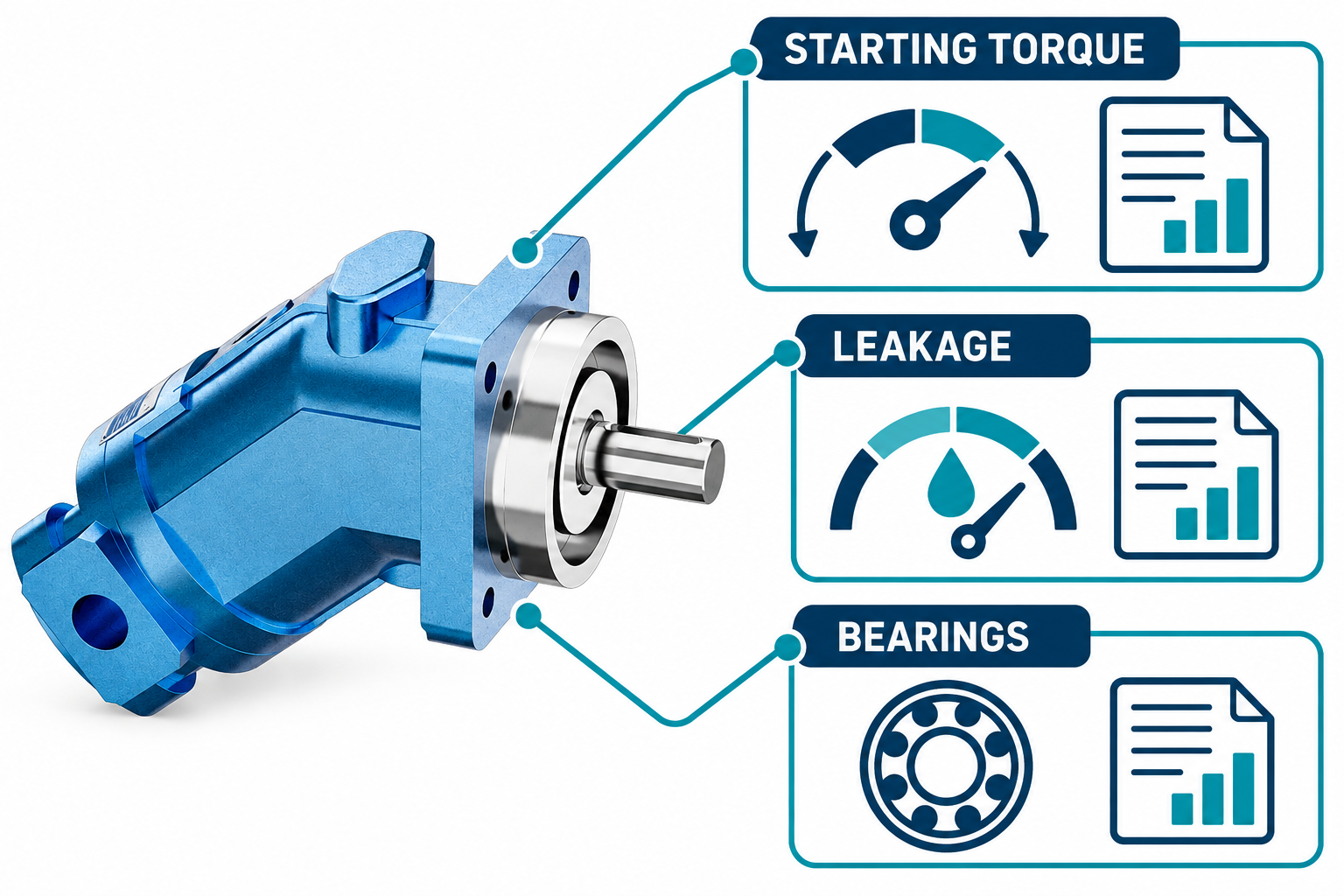
Repair a hydraulic motor when the fault is sufficiently defined, the repair can restore the required mechanical and hydraulic functions, and testing can demonstrate that recovery under the relevant duty. Choose replacement, or obtain further engineering review, when damage or parts identity is uncertain, important load-carrying features cannot be restored confidently, or the outage cost makes repair unattractive. A motor that rotates freely on a workshop bench has not necessarily recovered starting torque, brake compatibility, shaft support, or stable low-speed behavior.
The decision concerns restoration of the motor’s useful output. It is different from choosing a displacement or checking whether a replacement has the same flange. Those checks remain necessary after the recovery option has been selected.
Start with the load that the motor must move
Describe what the driven equipment was doing when the problem appeared. A conveyor that struggles to start fully loaded presents a different question from a fan that reaches speed but leaks externally. State load direction, starting frequency, minimum useful speed, reversing behavior, and any holding or braking arrangement. Include conditions that cannot be reproduced safely on the machine.
Do not assume that the motor alone caused slow movement. Insufficient delivered flow, a control restriction, an open bypass, a brake that has not released correctly, or excessive driven-machine resistance can produce similar complaints. Compare pressure difference across the motor, speed, relevant flow, and temperature under documented conditions. The purpose is to avoid purchasing a hydraulic repair for a mechanical or circuit fault elsewhere.
Separate torque recovery from speed recovery
Flow and displacement influence motor speed, while pressure difference and displacement contribute to torque. Losses and mechanical condition affect actual performance. A repair can improve one observation without proving the other. For example, a motor might run at an acceptable unloaded speed yet fail to accelerate the actual load, or operate under moderate load but behave poorly during repeated starts.
Ask the provider which performance conditions will be reproduced. Starting behavior, steady operation, leakage, and temperature-dependent results may require different observations. A theoretical torque calculation is useful for checking the meaning of measurements, but it is not a substitute for the selected motor’s rating or a measured acceptance result. Keep nominal catalog values separate from repair-test evidence.
Identify which functional parts are involved
A hydraulic motor combines pumping geometry operating in reverse as an energy converter, shaft support, sealing, and distribution of flow. The exact arrangement varies between motor types. Some installations add brakes, sensors, flushing arrangements, or external control valves. A quotation must identify which parts belong to the repair and which remain outside its scope.
For a piston motor, do not assume a replacement seal resolves wear at internal working interfaces. For an orbital motor, do not assume that a similar-looking rotating set has the same displacement or distribution arrangement. Housing, shaft, and bearing condition can matter independently of leakage. Ask the provider to distinguish reusable assemblies, renewed items, adjustment work, and parts whose suitability has not yet been established.
Treat shaft and bearing damage as a different decision
The driven arrangement may apply radial or axial loads to the shaft. A chain sprocket, pulley, or misaligned coupling can introduce a load that a pressure-and-flow test does not reproduce. If bearings or the shaft have been damaged, review the installation load path as well as the repair quotation. Moving a sprocket farther out on the shaft can change loading even when the hydraulic duty is unchanged.
Use the selected motor’s permissible shaft-load data and installation drawing. This guide does not provide a universal acceptable overhang, bearing clearance, or shaft runout. A qualified assessment is needed where damage affects interfaces, retention, or load-carrying integrity. Replacing the motor without addressing the external mechanical load can reproduce the failure in the new assembly.
Compare recovery options by consequence
| Frage | Repair may be a sound option when | Replacement or more review is favored when |
|---|---|---|
| Hydraulic function | Correct parts and a relevant performance test are available | Internal configuration or test reference is uncertain |
| Mechanical condition | Shaft, mounting, and bearing condition can be assessed and restored | Structural or interface damage remains unresolved |
| Driven equipment | Original cause can be corrected within the recovery job | External shaft loads or binding remain unassessed |
| Braking and controls | Integrated and external functions are included in the review | Motor rotation is checked but holding behavior is ignored |
| Outage | Defined repair time fits the operational requirement | Inspection-dependent repair time carries greater downtime risk |
| Beweis | Written scope and traceable results identify this motor | Generic claims or another motor’s report are offered |
The table organizes the decision. It does not establish model-specific wear limits or authorize continued use of damaged equipment.
Cost the complete job, including repeat-failure exposure
Compare removal, transport, inspection, parts, labor, installation, oil-system work, commissioning, and downtime. Keep costs common to both options visible. A replacement may require adapters or a revised control setup; a repair may require additional parts discovered only after opening. Ask how each uncertainty changes the authorization and price.
An illustrative decision can compare a defined repair plus two days of outage with a readily available replacement plus one day of outage. The economic result depends on the machine’s actual unavailable-production cost and the confidence in both delivery commitments. There is no universal repair-to-new-price percentage that accounts for this. NASA’s reliability-centered maintenance guidance supports evaluating consequences and maintenance costs together; it is not a motor-specific pricing schedule.
Include brakes and overhauling loads in the boundary
A motor may be part of a system that must control an overhauling load, prevent runaway movement, or hold equipment after stopping. An unloaded workshop test does not validate those functions. Identify whether the brake is integral, external, or part of another assembly, and identify who verifies its release and holding behavior.
Do not change brake or load-control settings to disguise a motor problem. The approved circuit and machine procedures determine how those functions are tested. Where a load could move unexpectedly, secure it using the appropriate engineered method before service work. Electrical isolation alone does not necessarily remove hydraulic pressure, gravitational energy, or the possibility of movement driven back through the motor.
Specify a useful acceptance test before authorizing work
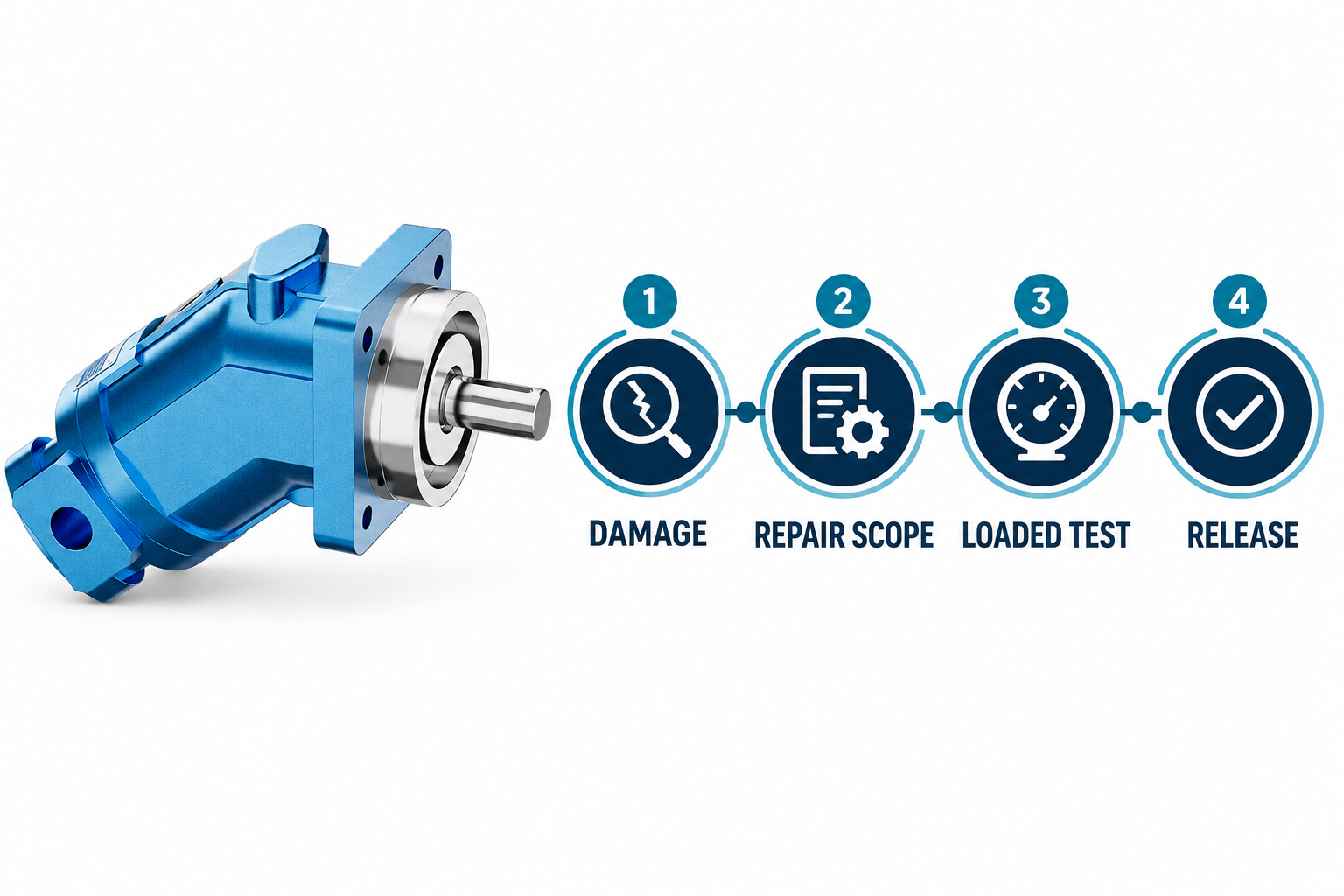
An acceptance agreement should identify the motor, fluid, temperature, speed or flow conditions, pressure difference, measurement locations, relevant mechanical conditions, and pass criteria. State whether tests include both rotation directions, repeated starts, or controls fitted to the actual unit. Only include tests relevant to the design and the intended use.
Separate observations from interpretations. A drain-flow result, for example, needs the applicable routing and test conditions; a number without those details is not a complete assessment. Ask for the instrument reference and whether results were measured or calculated. If the provider cannot reproduce the full machine load, document what the bench proves and what must still be verified during controlled commissioning.
Decide what to do when the exact motor is obsolete
Obsolescence does not automatically make an uncertain repair acceptable. It changes the available options. A specialist may have verified parts and test capability; alternatively, an approved replacement may require mechanical, hydraulic, or control changes. Compare the engineering work and resulting supportability as part of the decision.
Do not use a photograph or basic displacement label as sufficient evidence of interchangeability. The required port functions, shaft, mounting, allowable loads, pressure and speed limits, and control behavior must be confirmed. Keep repairability and interchangeability as separate questions. A repair proposal that changes the original specification should be treated as an engineering change, not quietly recorded as restoration of the same motor.
Close the cause before returning to production
A repaired motor should not return to a contaminated or mechanically defective installation. Review fluid condition, debris, filter findings, external loads, coupling alignment, drain routing where applicable, and the driven equipment. Assign responsibility for each correction rather than assuming the workshop or installer has covered it.
Use a staged restart with defined stop conditions. First verify the permitted installation and hydraulic arrangement, then evaluate movement and the necessary operating duty under the machine’s approved procedure. Record speed, load-related conditions, temperature, and any evidence that prompted the original repair. The useful endpoint is a restored function with traceable evidence, rather than a motor that has merely been returned and bolted into place.
Häufig gestellte Fragen
Is a normal no-load speed enough to approve a repaired motor?
No. It shows only part of the behavior under those test conditions. Loaded starting, leakage, shaft support, braking interfaces, and temperature-dependent performance may still be unresolved. Agree on the relevant test coverage for the actual machine duty.
Does bearing failure always require a new motor?
Not automatically. A qualified inspection must establish the extent of damage and whether the correct parts and interfaces can be restored. The installation’s shaft loading must also be reviewed, otherwise a new motor may suffer the same problem.
Can a larger motor solve a repeat repair problem?
Only after a proper application review. A different displacement or housing does not by itself correct contamination, an unreleased brake, mechanical binding, or excessive shaft loads. It may also change speed, flow requirements, and control behavior.
What should a repair quote say about the test?
It should identify the particular assembly, agreed conditions, measured outputs, acceptance reference, and exclusions. A statement that the unit has been tested is incomplete if it does not reveal what was tested or how the result relates to the required duty.
What records help make the next decision easier?
Retain identity photographs, the original complaint, operating measurements, damage findings, repair scope, replaced parts, final test report, installation corrections, and commissioning results. Linking these records makes it easier to distinguish a new failure from a recurring unresolved cause.
Produktdaten und entsprechende technische Ressourcen
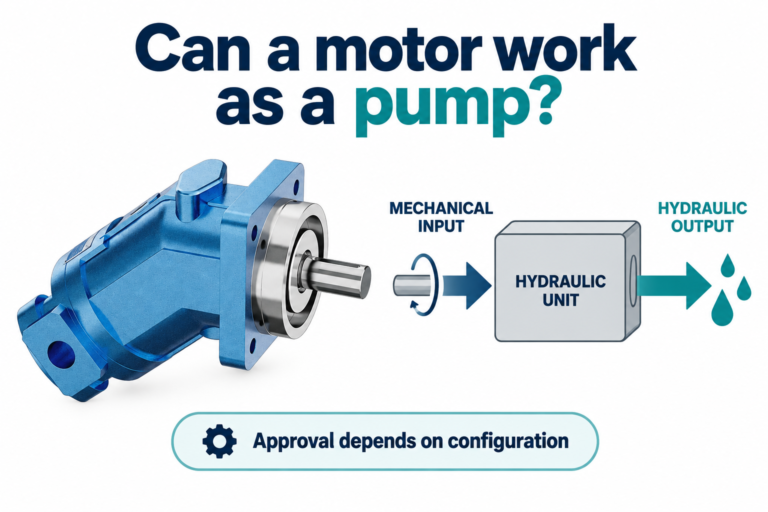
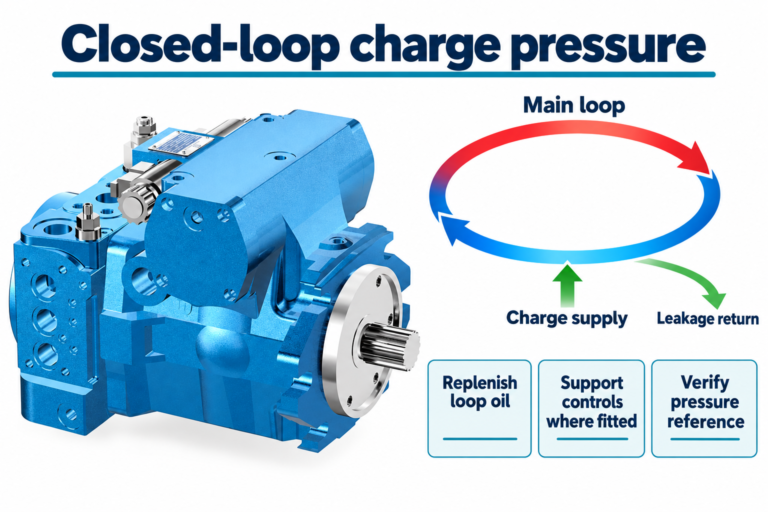
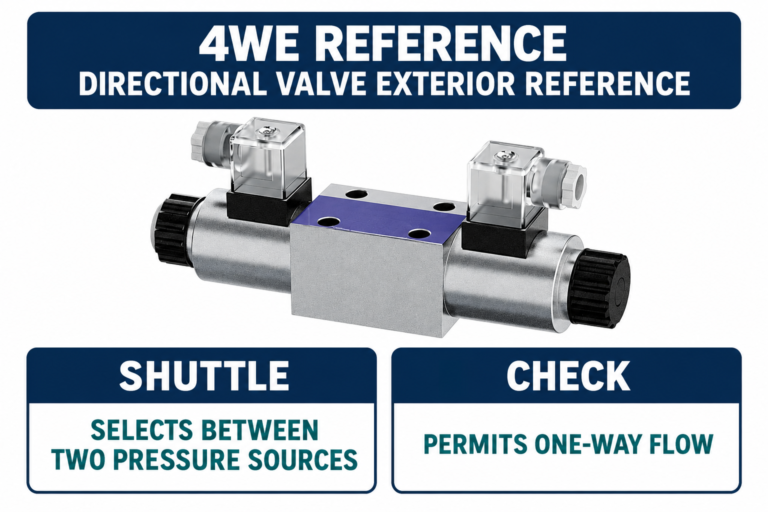
The Fixed Displacement Motor A2FM catalog exterior is used as the real product reference in these explanatory images. It does not establish the approved service method, optional construction, or operating limits for an individual order. Confirm the complete code and its documentation. Related resources: Konstantmotor A2FM, Hydraulikmotor-Palette, Hydraulic Motor Replacement Checklist for Mobile Equipment, Test des Abflussflusses des Hydraulikmotors: Messung der internen Leckage, Fehlfunktion des Hydraulikmotors: Symptome und Ursachen.
Sources and limits of this guide
The university resource supports the component operating principles. NIOSH supplies hazardous-energy prevention context; exact machine isolation and component service requirements still need their approved procedures. NASA supplies a general maintenance decision framework, not hydraulic repair prices or component acceptance limits.
- NPTEL: Grundlagen der industriellen Ölhydraulik und Pneumatik
- NIOSH: Verletzungen durch gefährliche Energie verhindern
- NASA: Reliability-Centered Maintenance Guide
University lesson: operating principles
NPTEL-NOC IITM presents 6.3 – Hydraulic Motors. The lesson supports the motor operating principles used in the engineering discussion; it is not a model-specific repair, storage, or installation approval.