Wenzhou Prance Hydraulic Equipment Co., Ltd

Hydraulic Pump Pressure vs Flow: What Controls Speed and Force?
Hydraulic pump pressure vs flow is easiest to understand by separating the jobs they perform: flow is the volume of oil moving through the circuit, while pressure is the force per unit area produced when that flow meets resistance. Pump displacement and speed largely determine available flow; the load, restrictions, valve settings, and losses determine the pressure required at a given moment. More flow usually makes an actuator move faster. More pressure allows it to overcome a larger resisting load. A pressure gauge cannot prove that enough flow reaches the actuator, and a flow reading without pressure does not show whether the circuit can carry the load. Correct diagnosis therefore measures both under controlled conditions.
Pressure and flow are related, but they are not interchangeable
Hydraulic power transfers energy through moving liquid. Volumetric flow is commonly expressed in liters per minute or US gallons per minute. Pressure is commonly expressed in bar, pascals, or pounds per square inch. A positive-displacement hydraulic pump traps and transfers a volume of oil each shaft revolution. The ideal flow therefore follows displacement and rotational speed. Real flow is lower because internal leakage increases with clearance, viscosity, wear, and pressure differential.
The circuit develops pressure only as it resists flow. With a directional valve open to tank and little restriction, a fixed-displacement pump can move substantial oil at low pressure. When a cylinder meets a load, resistance rises and pressure increases until the load moves, a relief valve opens, a compensator destrokes the pump, or another limit is reached. The University of Florida explains the basic positive-displacement principle and notes that excessive discharge pressure can damage a pump or line; this is why a safe pressure-control path is essential. See the university’s discussion of positive-displacement pumps.
What controls hydraulic pump flow?
For a fixed-displacement pump, theoretical flow is the displacement per revolution multiplied by shaft speed. If displacement is stated in cubic centimeters per revolution and speed in revolutions per minute, dividing the product by 1,000 gives theoretical liters per minute:
Theoretical flow (L/min) = displacement (cm³/rev) × speed (rev/min) ÷ 1,000
Actual delivery is theoretical flow multiplied by volumetric efficiency. Because efficiency is not constant across speed, temperature, viscosity, pressure, and wear, a calculated value is a starting point rather than a substitute for the manufacturer’s performance data. Our separate guide shows how to perform a hydraulic pump flow calculation and interpret the result.
A variable-displacement pump adds another control input: the rotating group can change effective displacement. A pressure-compensated pump may reduce displacement after system pressure reaches its control setting. A load-sensing pump changes displacement to maintain the required margin across the metering valve. In both cases, a low flow reading may be normal control behavior rather than pump damage. Record command signal, compensator or load-sense setting, valve position, and test pressure before drawing a conclusion.
What controls hydraulic pressure?
The pump provides the energy and flow that make pressure possible, but the operating pressure is set by the circuit’s demand. On a cylinder, required pressure depends on load force and effective piston area, plus friction and losses. On a hydraulic motor, pressure differential is associated with output torque, while flow is associated with rotational speed. Line restrictions, filters, coolers, hoses, fittings, and valve metering edges also consume pressure without producing useful actuator force.
A relief valve limits maximum pressure by diverting flow when its setting is reached. It does not make the pump produce a fixed pressure during every operating condition. Likewise, installing a higher-pressure pump does not automatically increase pressure if the load and control settings remain unchanged. Any change to pressure capability must consider every component in the pressure envelope. OSHA documents a fatal incident after a system was modified from 3,000 to 5,000 psi without replacing lower-rated hoses, illustrating why hydraulic system modifications require a complete safety review.
Pressure symptom or flow symptom?
| Observed symptom | First quantity to verify | Possible circuit causes | What not to assume |
|---|---|---|---|
| Cylinder is slow in both directions | Flow at the required load pressure | Low pump speed, destroking, leakage, flow control, restricted inlet | Do not assume the relief setting is too low |
| Cylinder moves at normal speed but cannot lift the load | Pressure at pump and actuator ports | Relief opening early, load too high, internal leakage, wrong cylinder area | Do not assume a larger pump flow will add force |
| Motor has torque but runs slowly | Flow through the motor | Low commanded flow, bypass leakage, incorrect displacement, supply limit | Do not raise pressure without checking the speed requirement |
| System heats while actuator stalls | Pressure and return flow together | Relief flow, excessive throttling, leakage, closed path | Do not continue holding the stall condition |
| Pressure fluctuates and movement is erratic | Pressure, flow, oil level, and inlet condition | Aeration, cavitation, unstable control, intermittent restriction | Do not condemn the pump from noise alone |
Why a pressure gauge alone can mislead
A gauge can show normal standby or relief pressure even when useful delivery is inadequate. For example, a worn pump may build pressure against a nearly closed test path while delivering too little flow at operating pressure to move the actuator at the required speed. Conversely, a healthy pump may show low pressure when its outlet is unloaded to tank. A pressure reading is meaningful only when paired with the circuit state, test location, oil temperature, pump speed, and expected load.
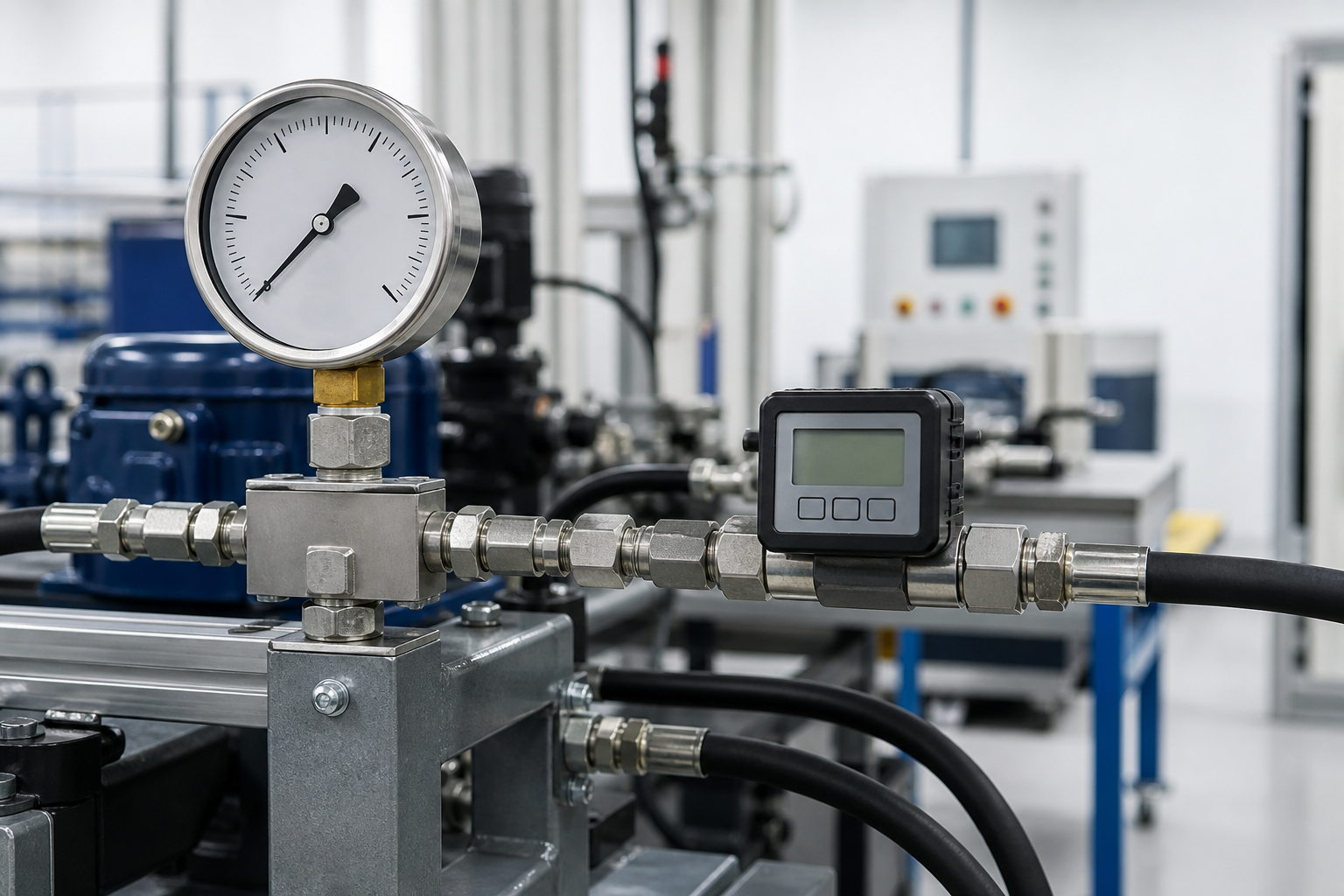
A flow meter adds the missing volume information, but it must be rated for the fluid, flow range, pressure, temperature, and direction. Positive-displacement flowmeters directly measure volumetric flow by repeatedly filling and emptying a known chamber, as described by the University of Michigan’s Visual Encyclopedia of Chemical Engineering Equipment. The chosen meter and loading valve must be installed according to their documentation.
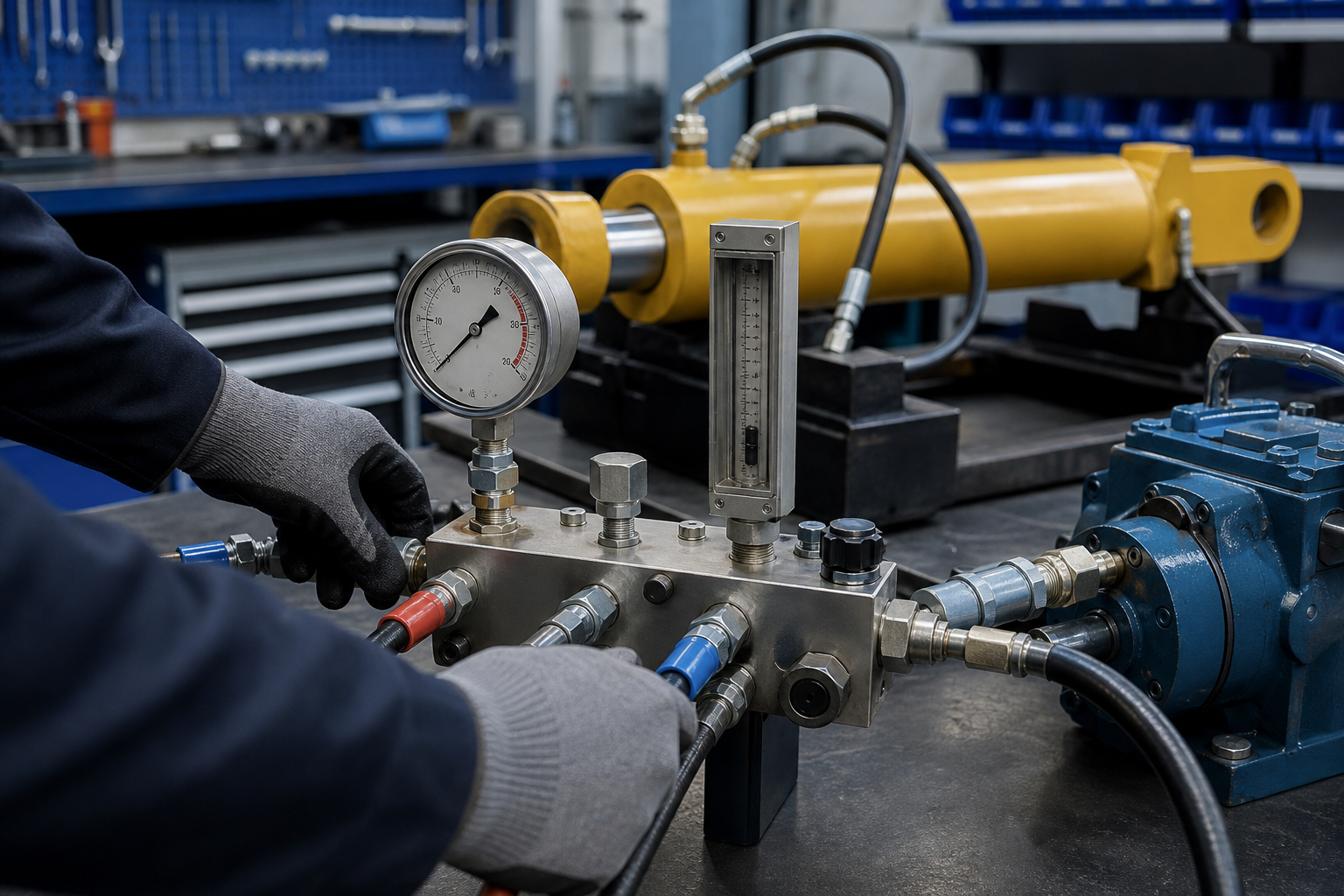
A safer pressure-and-flow test sequence
- Identify the circuit and ratings. Confirm pump type, displacement, rotation, drive speed, relief or compensator arrangement, expected flow, hose ratings, and approved test ports.
- Inspect before energizing. Check oil level, obvious leakage, hose condition, loose fittings, guards, and instrument ratings. Never search for a high-pressure leak with a hand.
- Warm the system normally. Record fluid temperature because viscosity changes leakage and pressure loss. Follow the equipment manufacturer’s warm-up procedure.
- Measure at low load first. Verify rotation, inlet condition, basic flow, and abnormal noise before introducing a controlled load.
- Increase load gradually. Use approved test equipment and remain within component ratings. Record flow at several pressure points rather than relying on one number.
- Compare locations. Pressure differences across filters, valves, hoses, or coolers identify where energy is being lost. Case-drain or return measurements can help locate internal leakage when the manufacturer’s procedure permits them.
- Return controls to the documented state. Remove test equipment safely, restore settings, inspect for leakage, and record the final configuration.
Hydraulic fluid exposure also deserves attention. The US Agency for Toxic Substances and Disease Registry notes that hydraulic fluids vary in composition and that some can irritate skin or eyes; consult the fluid safety data sheet and the agency’s hydraulic fluids public-health statement.
How pump type changes the interpretation
A fixed gear, vane, or piston pump continues trying to displace oil while its shaft turns, so blocked flow must have an approved relief path. A pressure-compensated variable piston pump can reduce displacement near its control setting, but it still needs correct commissioning and protective controls. Closed-loop hydrostatic transmissions add charge pressure, loop flushing, cross-port relief, and control behavior that cannot be interpreted from a single outlet gauge. Always use the exact circuit diagram and pump data rather than applying one generic test.
If you are comparing pump families, review Prance Hydraulic’s hydraulic pump overview and the available hydraulic product families. The guides on fixed versus variable displacement pumps, hydraulic pump inlet conditions, and hydraulic pump efficiency provide complementary checks without replacing the manufacturer’s limits.
Educational video: do pumps create pressure or flow?

Watch on YouTube if the privacy-enhanced player is unavailable. The demonstration is educational and does not replace machine-specific engineering instructions.
FAQ
Does a hydraulic pump create pressure or flow?
A positive-displacement hydraulic pump transfers a volume of fluid as it rotates and supplies energy to the fluid. Circuit resistance creates the pressure needed to move the load. The practical result depends on the pump, controls, relief path, and connected circuit.
Will a larger hydraulic pump increase pressure?
A larger displacement pump usually increases available flow at the same speed. It does not automatically raise operating pressure. Pressure follows load demand and pressure-control settings, subject to component ratings and losses.
Why can a pump show pressure but no useful movement?
The system may reach pressure with insufficient flow because of pump leakage, a bypass path, a valve problem, actuator leakage, low drive speed, or a variable pump that has destroked. Measure flow at operating pressure and compare test locations.
Does higher flow make a hydraulic cylinder stronger?
Higher flow primarily increases cylinder speed. Cylinder force depends mainly on pressure acting on effective piston area, minus friction and other losses.
What information should be included in a pump inquiry?
Provide pump type, displacement, rotation, shaft and mounting details, drive speed, fluid and temperature range, target flow, continuous and peak pressure, circuit type, control method, duty cycle, filtration target, and current model code. Our hydraulic pump RFQ checklist organizes those inputs.