Wenzhou Prance Hydraulic Equipment Co., Ltd.

Charge-Filter Bypass Signals: Cold-Oil Restriction vs Persistent Blockage
A hydraulic charge-filter warning during cold startup does not, by itself, prove that the element is blocked or that the bypass valve has opened. Cold, viscous oil can increase pressure drop across a clean element. The warning device and bypass valve may also have different thresholds, reset behavior and locations. Identify the actual filter circuit, verify the indicator type and compare temperature, flow and differential pressure under the manufacturer’s permitted procedure. A warning that persists at the specified operating condition requires investigation; simply clearing the lamp or removing the filter does not establish that the pump is protected.
Identify what the indicator actually measures
A differential-pressure indicator responds to the pressure difference between two connected locations. Depending on its design, a filter warning may instead respond to pressure relative to tank or atmosphere, or to an electrical signal processed by the machine controller. Do not assume that every red lamp is a direct measurement of filter loading. Read the indicator code, circuit diagram and controller description before interpreting it.
A high charge-pressure reading is not the same as high differential pressure across a charge filter. The two require different measurement references. To illustrate the distinction, assumed pressures of 24 bar upstream and 22 bar downstream give a 2-bar difference. Those are arithmetic examples, not recommended operating values or filter thresholds. Actual readings must use the locations, instruments and conditions specified for the installed assembly.
Establish where the charge filter sits
Closed-loop systems can use different charge filtration arrangements. A filter on a supply-pressure path presents different diagnostic consequences from a filter on the charge-pump inlet. Restrictions may affect replenishment, control supply or other functions according to the circuit. Trace the oil route from the reservoir through the charge arrangement to the working loop and case; do not infer it from the filter’s physical proximity to the pump.
The Danfoss H1T manual provides a reference example of charge filtration and associated pressure checks. It does not establish the arrangement fitted to every AA4VG unit or machine installation. Obtain the selected pump schematic and the external filtration drawing together. Confirm whether the filter has a bypass, where that bypass sends oil and whether an indicator measures across the element or another combination of components.
Why cold oil can trigger a clean element’s warning
Flow through an element and its housing creates a pressure drop. Higher viscosity during cold operation can increase that restriction even without additional dirt. The HYDAC indicator guidance specifically discusses cold-start signals and optional thermal lockout. This supports checking temperature as part of the diagnosis; it does not mean that every cold warning is harmless or that the operator may continue at unrestricted duty.
Flow matters as well. A warning at a higher pump speed may disappear at a lower speed because the pressure-drop condition changes. That response alone cannot distinguish a clean element from a partly loaded one. Compare observations at documented operating conditions. If charge supply falls below its permitted boundary, use the machine’s stop procedure rather than continuing operation merely to wait for the lamp to clear.
Warning threshold and bypass opening are separate events
An indicator commonly provides a maintenance warning before the assembly reaches a bypass condition, but the actual relationship belongs to the selected filter, indicator and element. Do not use a general catalog example as the threshold for another installation. Some filters do not have a bypass at all. Others combine a bypass arrangement with monitoring that does not directly report valve position.
Consequently, a lamp cannot universally prove that unfiltered oil is circulating, and a dark lamp cannot universally prove that the element is filtering correctly. Determine the installed indicator’s meaning and bypass configuration. If bypass operation must be established, use the manufacturer’s specified evidence. Do not dismantle or hold a bypass open during a running test to see whether the warning changes.
Use a temperature-aware decision table
The following qualitative table draws on the manufacturer indicator guidance and the reference pump manual. It intentionally contains no universal pressure threshold or service interval.
| Observación | Explicación posible | Required check before deciding |
|---|---|---|
| Warning only during permitted cold startup | Viscosity-related pressure drop or a partly loaded element | Check approved warm-up conditions and the later differential reading |
| Warning persists at specified operating temperature | Element loading, unsuitable element, excessive flow or another restriction | Verify element code, flow condition and measured pressure drop |
| Lamp changes without a corresponding hydraulic change | Wiring, contact selection or controller interpretation issue | Compare the actual indicator output with the documented logic |
| Visual flag stays out after shutdown | A manual-reset indicator may retain the earlier event | Identify reset type before judging current differential pressure |
| New element quickly produces the same warning | Contamination ingress, fluid problem, wrong element or circuit fault | Investigate the cause rather than repeatedly resetting the signal |
| Charge pressure falls while restriction increases | Supply may be affected by the installed circuit arrangement | Follow the machine stop criteria and approved charge-circuit diagnosis |
Distinguish a reset from a repair
HYDAC describes automatic-reset electrical indicators and visual indicators with different reset behavior. An electrical switch may return after the differential pressure falls, while a manual visual flag can retain the earlier indication. Read the actual device instructions. A retained flag after shutdown need not mean that a pressure difference still exists, and an automatically cleared lamp does not erase the earlier event.
Thermal lockout is also a signal-management feature with specific operating conditions. It can suppress a cold-start warning in an approved application; it does not remove hydraulic restriction or filter the bypassed flow. Do not add a delay, bridge a switch or change controller logic simply to hide nuisance warnings. First establish whether the hydraulic conditions meet the pump and filter requirements throughout startup.
Check the element identity before changing the circuit
Match the replacement element to the approved part code, filtration requirement, flow direction, seals, dimensions and pressure capability. Physical fit alone does not demonstrate equivalence. An element with a different resistance characteristic may change cold-start behavior even when its nominal filtration description looks similar. Obtain compatibility confirmation rather than substituting a coarser element to extinguish the lamp.
Inspect service history and recent changes. A warning that began immediately after maintenance suggests checking the installed element, fluid grade, valve positions and electrical connection before condemning the pump. A gradual increase under otherwise consistent conditions may support a loading investigation. Neither pattern proves the cause alone, but both help choose the next inspection and avoid replacing unrelated components.

Restriction is not a cleanliness measurement
cURL Too many subrequests by single Worker invocation. To configure this limit, refer to https://developers.cloudflare.com/workers/wrangler/configuration/#limits.
cURL Too many subrequests by single Worker invocation. To configure this limit, refer to https://developers.cloudflare.com/workers/wrangler/configuration/#limits.

cURL Too many subrequests by single Worker invocation. To configure this limit, refer to https://developers.cloudflare.com/workers/wrangler/configuration/#limits
cURL Too many subrequests by single Worker invocation. To configure this limit, refer to https://developers.cloudflare.com/workers/wrangler/configuration/#limits.
cURL Too many subrequests by single Worker invocation. To configure this limit, refer to https://developers.cloudflare.com/workers/wrangler/configuration/#limits.
cURL Too many subrequests by single Worker invocation. To configure this limit, refer to https://developers.cloudflare.com/workers/wrangler/configuration/#limits.
Preguntas frecuentes
Does a charge-filter warning mean the bypass is open?
Not necessarily. The warning threshold and bypass opening condition can differ, and some filters have no bypass. Identify the assembly and indicator logic. Use the manufacturer's diagnostic method before describing the signal as proof of bypass flow.
Can cold oil trip a clean filter indicator?
Yes, increased viscosity can raise pressure drop enough to trigger some indicators. This does not authorize unrestricted cold operation. Check the permitted startup procedure and whether charge supply and later operating readings remain within their specified boundaries.
Is it safe to fit a coarser element to stop the warning?
Only a manufacturer-approved element should be used. Changing filtration can affect cleanliness protection and compatibility. First verify the existing part code, fluid, flow and pressure-drop condition instead of selecting an element solely because it clears the lamp.
Why does a visual warning remain after shutdown?
Some visual indicators latch and require a manual reset, whereas other devices reset automatically. Identify the exact type. A retained flag records an earlier condition; resetting it does not establish that the cause has been corrected.
What should I send for a charge-filter diagnosis?
Provide the pump, filter, element and indicator codes, the schematic, fluid grade and the temperature-flow condition of the warning. Add synchronized differential-pressure, charge-pressure and signal observations where safely available. Include recent maintenance and any replacement-part changes.
Recursos relacionados de productos e ingeniería
Bomba de pistones de desplazamiento variable de circuito cerrado AA4VG, gama de productos de bombas hidráulicas, Cuentas de limpieza de aceite hidráulico: ISO 4406, objetivos por componente, Presión de carga en circuito cerrado: qué suministra y cómo diagnosticar la pérdida. Confirmar el código completo del producto y los requisitos de aplicación al solicitar una revisión de configuración.
Referencias técnicas
- HYDAC: Clogging indicator operation and thermal lockout
- Danfoss H1T service manual: reference pressure protection and filtration architecture
- NIOSH: Preventing Deaths from Uncontrolled Hazardous Energy
Aprendizaje adicional: bombas hidráulicas
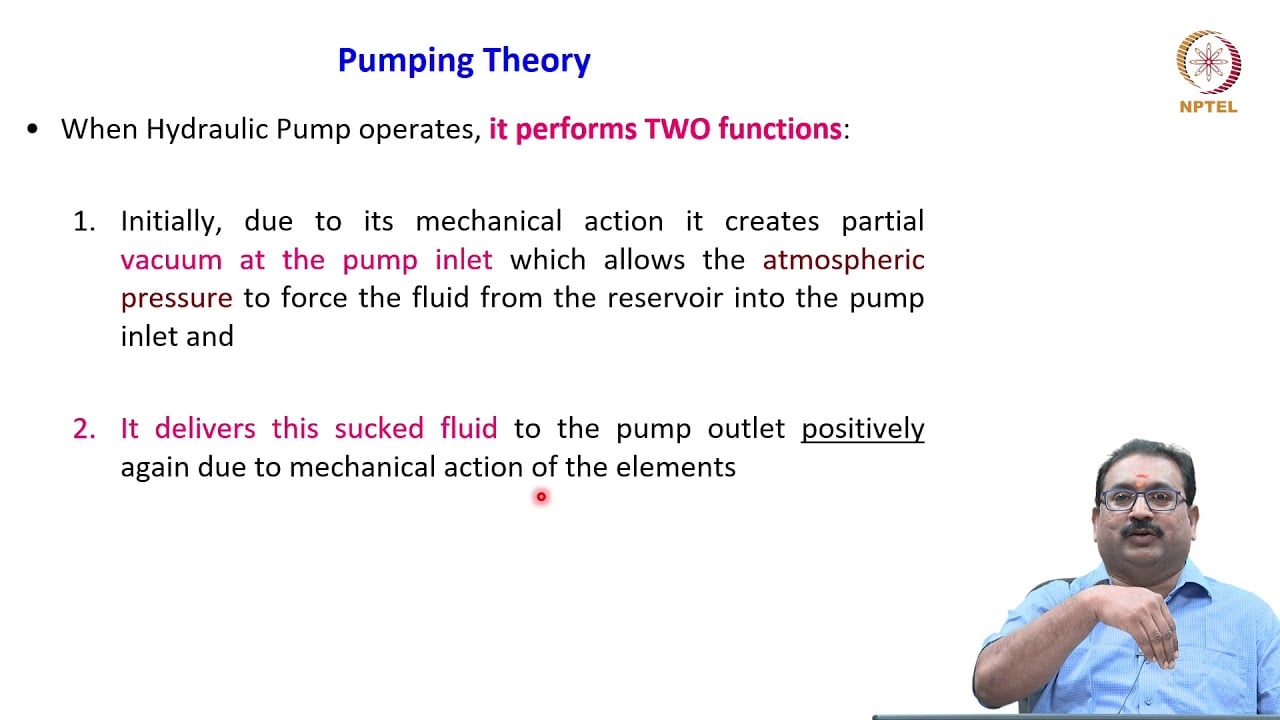
3.2 – Hydraulic Pumps by NPTEL-NOC IITM provides background on pump operating principles. Pump fundamentals explain the supplied component; this lecture does not establish filter bypass thresholds or a service interval. It supplements the component fundamentals; it is not a test procedure for the complete circuit discussed above.